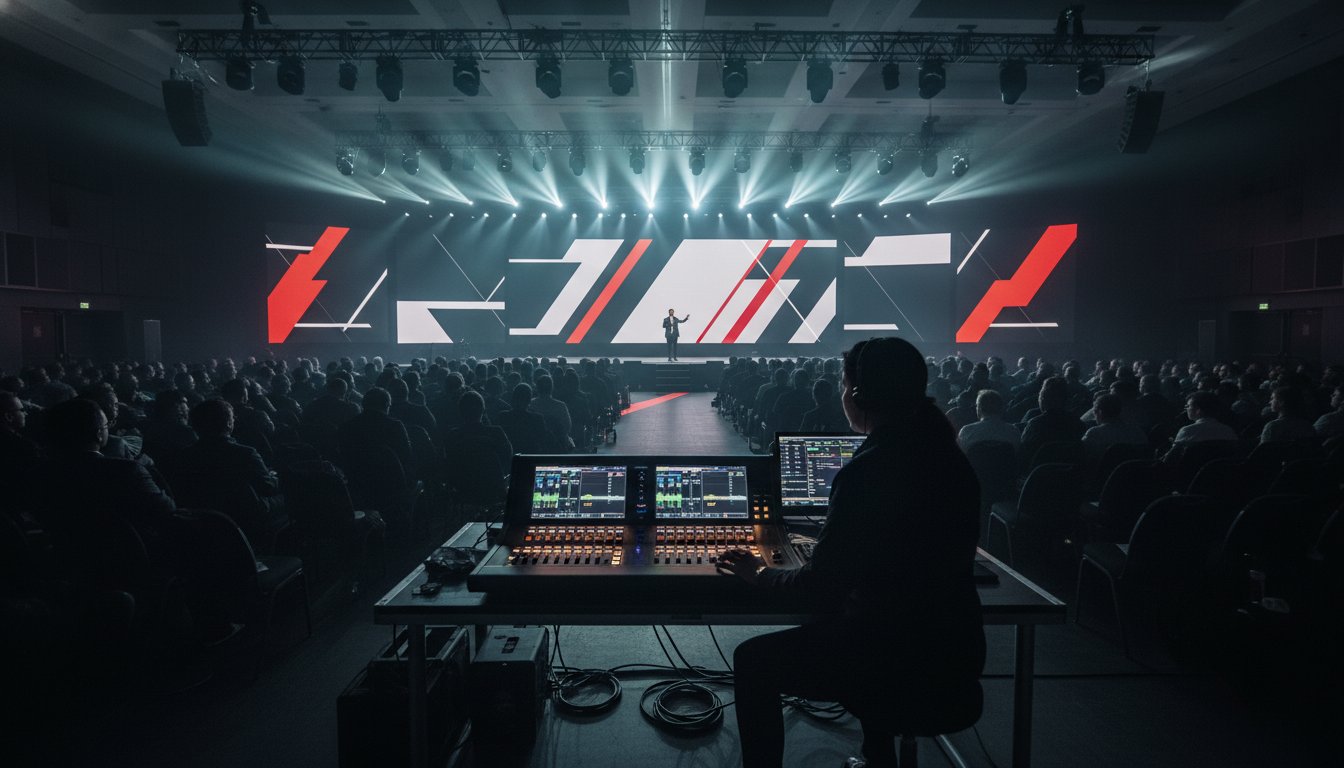
If your audience notices the technical team during a presentation, the production has already failed. True technical support for events isn't just a safety net designed to catch mistakes; it's a proactive engine that ensures those mistakes never happen in the first place. You've likely spent weeks stressing over potential audio feedback or the complexity of hybrid connectivity, wondering if your vision will actually translate to the screen. It's a common pressure for any organizer who wants to move beyond simple gear rentals toward a truly seamless, professional experience.
In this article, you'll discover why expert technical support is the invisible backbone of flawless execution and how to identify true production mastery. We'll demystify confusing jargon like LED pitch and power phases while exploring the real-world value of specialized production management. From optimizing concert audio systems to deploying precision lighting, we'll show you how a steady technical hand turns potential stress into high-quality audience engagement and a lasting impact for your brand.
Key Takeaways
- Learn to distinguish between basic gear rentals and professional production management to secure a seamless event experience.
- Discover why proactive technical support for events is the essential backbone for preventing common audio and visual glitches before they occur.
- Explore the three pillars of production, focusing on how immersive audio systems and high-resolution LED walls elevate audience engagement.
- Understand the unique safety requirements for Western Canadian events, including critical wind load ratings for mobile stage rentals and outdoor structures.
- Gain a clear checklist for identifying true production expertise and ensuring transparency in your technical partner's proposal.
What is Technical Support for Events? Beyond the "AV Guy"
Technical support for events is frequently misunderstood as a reactive service. Many organizers picture a technician waiting in the wings to fix a flickering screen or a dead microphone. In reality, true support is the holistic management of audio, visual, and lighting systems. It's the silent architecture that holds your entire presentation together. While a "tech" might focus on operating a single piece of equipment, a production manager oversees the entire ecosystem. They ensure the stage lighting doesn't wash out the LED wall and that the audio delay is perfectly timed for the back of the room. It's a shift from merely "having gear" to "engineering an experience."
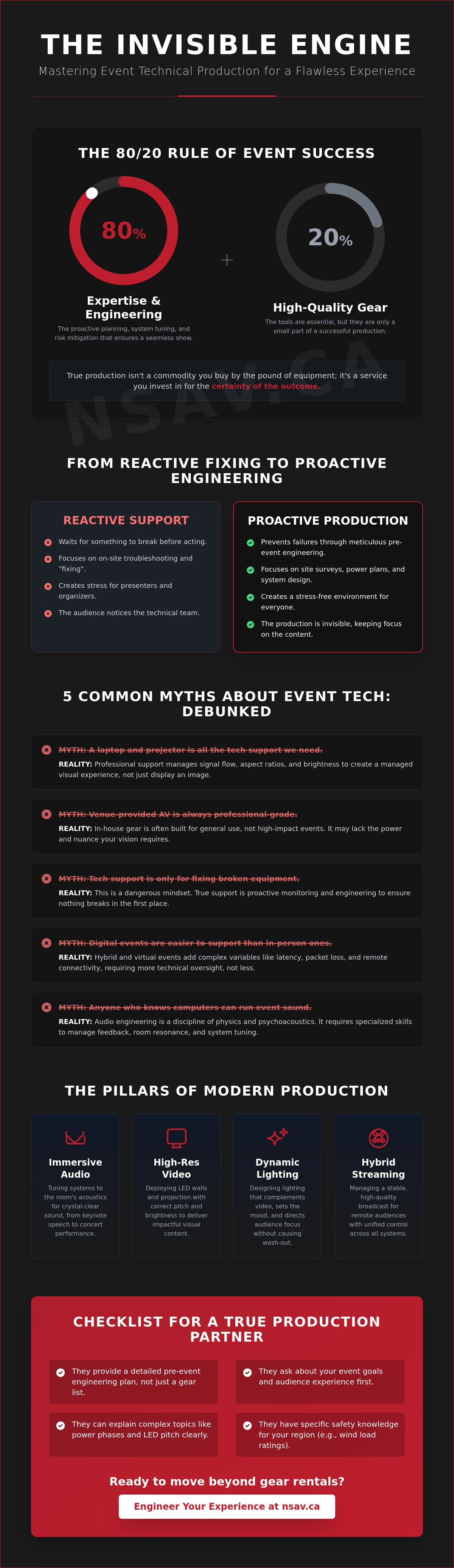
High-end support is inherently invisible. When it works perfectly, nobody mentions it. That success isn't an accident; it's a result of the 80/20 rule. High-quality gear accounts for only about 20% of a successful show. The remaining 80% is pure expertise. You can rent the most expensive line array in the world, but if it isn't tuned to the specific acoustics of the room, it's just a pile of heavy speakers. Professional production isn't a commodity you buy by the pound of equipment; it's a service you invest in for the certainty of the outcome, a philosophy shared by the team at Straight Street Event Services.
The Scope of Modern Event Technology
Modern Live event support covers four primary domains: immersive audio, high-resolution video, dynamic lighting, and hybrid streaming. These aren't isolated silos. They must communicate through a centralized control network to maintain perfect synchronization. This is where production management services become vital. They unify these disparate elements into a single, cohesive output. Whether it's a corporate gala or a large-scale concert, the technology must act as one. If the audience is looking at the technician instead of the stage, the production has failed to remain invisible.
On-Site Support vs. Pre-Event Engineering
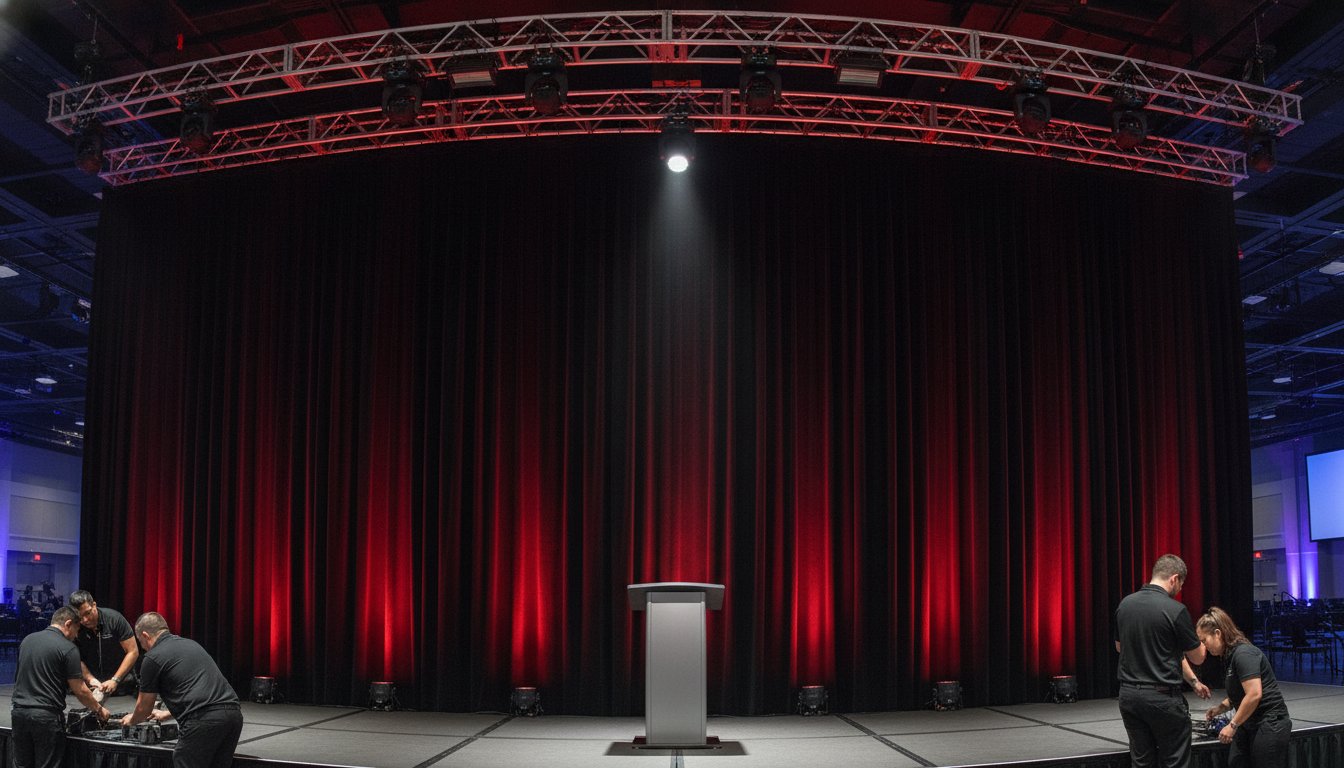
The most critical work usually happens weeks before the doors open. Pre-event engineering involves detailed site surveys to check power phases, ceiling heights, and rigging points. It includes reviewing technical riders to ensure the equipment matches the specific needs of your speakers or performers. This preparation prevents day-of disasters that no amount of on-site "fixing" could solve. Professional technical support for events is the proactive mitigation of environmental and hardware risks. It's about building a foundation where technical failure is mathematically minimized. When you prioritize engineering over last-minute troubleshooting, you create a stress-free environment for everyone involved.
5 Common Myths About Event Technical Support Debunked
Misconceptions about production often lead to avoidable failures. Many organizers view technical support for events as a simple commodity rather than a specialized discipline. This misunderstanding creates a gap between the expected outcome and the actual audience experience. To ensure your next project succeeds, we must dismantle the most persistent myths in the industry.
- Myth 1: "If we have a laptop and a projector, we have tech support." Hardware is just a tool. Support is the expertise required to manage signal flow, aspect ratios, and brightness levels. Without a professional, you're merely displaying an image; you aren't managing a visual experience.
- Myth 2: "Venue-provided AV is always professional-grade." Venue gear is often selected for its durability and ease of use for general meetings, not for high-impact brand launches. It frequently lacks the nuance required for complex lighting or immersive sound.
- Myth 3: "Technical support is only needed if something breaks." This is the most dangerous reactive mindset. High-level support is about proactive monitoring to ensure nothing breaks in the first place.
- Myth 4: "Digital events are easier to support than physical ones." Virtual and hybrid environments introduce variables like packet loss, latency, and remote connectivity issues. These require more technical oversight, not less.
- Myth 5: "Anyone who knows computers can run event sound." Audio engineering is a matter of physics and psychoacoustics. Knowing how to use a PC doesn't prepare someone to manage feedback loops or room resonance.
Myth-Busting: The "In-House AV" Trap
Many venues mandate exclusive in-house providers. These generalist teams often prioritize venue convenience over your specific creative goals. They might use "one size fits all" equipment lists that don't account for your brand's unique aesthetic. In contrast, specialized Calgary event production teams focus on custom engineering. We bring in gear specifically curated for your audience size and venue acoustics. External partners act as your advocate, ensuring the technical setup serves your message rather than just filling a room with standard equipment.
The Reality of "Set It and Forget It" Technology
Modern equipment is sophisticated, but it isn't self-sustaining. Factors like thermal shifts in a crowded room, power surges from catering equipment, and wireless signal interference require constant vigilance. Professional technicians spend their time behind the scenes of live events monitoring frequencies and temperature levels to prevent hardware fatigue. We deploy redundant systems and "backups for the backups" to guarantee continuity. Professional technical support for events acts as a comprehensive insurance policy for your brand reputation. If you want to ensure your vision remains uncompromised, it's time to partner with a team that values precision over guesswork.
The Three Pillars of Flawless Event Technical Production
A successful event relies on the seamless integration of three core technical disciplines. While they operate independently, they must be synchronized perfectly to create a unified experience. This synergy is the hallmark of elite technical support for events. It moves beyond simple equipment setup to a level of engineering that follows the standards set by the International Live Events Association (ILEA). When these pillars are managed correctly, the technology disappears, leaving only your message and the audience's reaction.
Audio Engineering: More Than Just Volume
Sound is the most critical element of any production. If an audience can't hear, the event doesn't exist. Professional audio engineering ensures every attendee, from the front row to the back of the balcony, experiences consistent clarity. This involves complex acoustic treatment and precise frequency management to eliminate resonance and feedback. Wireless microphone coordination is another vital layer; it prevents signal dropouts in environments crowded with competing radio frequencies. Our professional audio systems guide provides a deeper look into how sound engineers balance live music against the nuances of the spoken word. It's about maintaining a natural tone that feels intimate regardless of the room's size.
Visual Mastery: LED Walls and Signal Flow
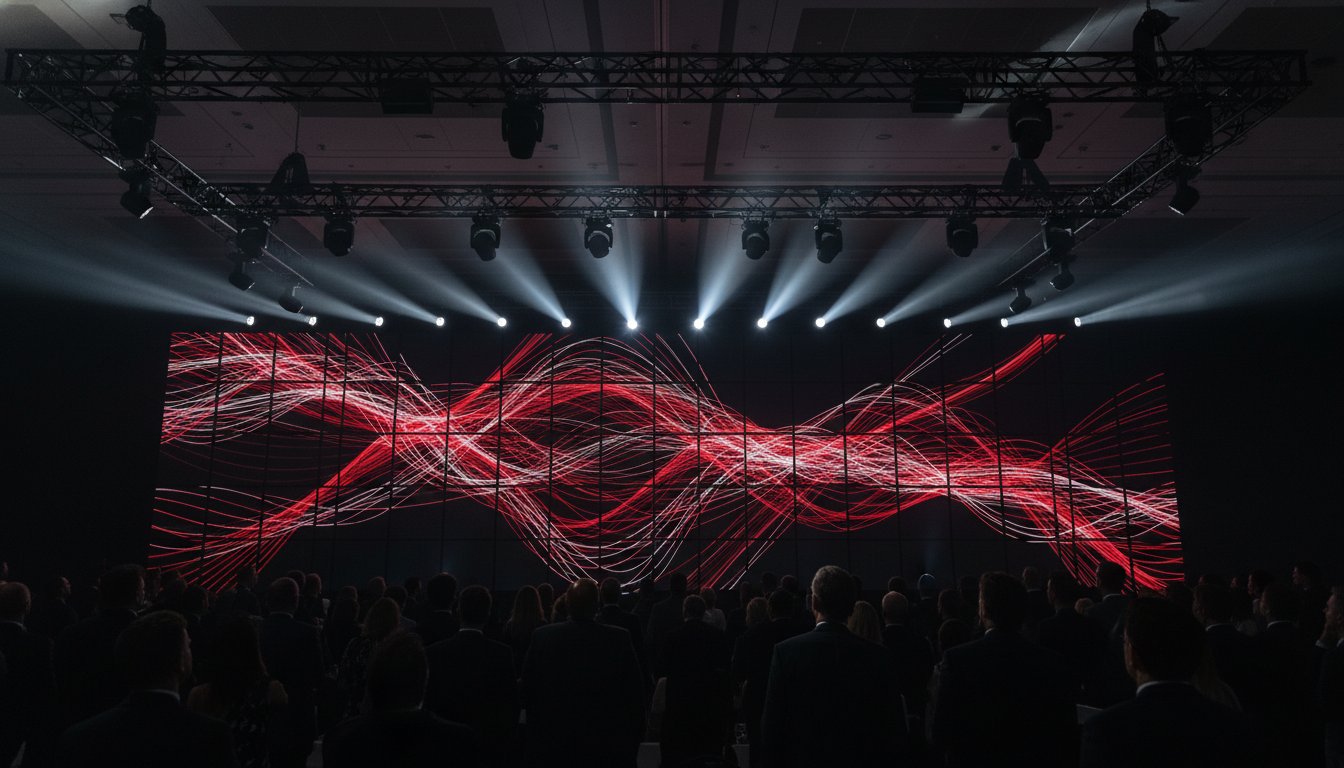
Visual displays have evolved beyond traditional projection. High-resolution LED walls are now the standard for corporate events because they offer superior brightness and contrast that isn't washed out by stage lighting. Managing these systems requires sophisticated technical support to handle multi-source video switching. Whether you're transitioning between a remote presenter on a hybrid stream and a local slide deck, the signal flow must be instantaneous. We ensure "pixel-perfect" delivery by mapping content specifically to the LED wall physical resolution. This precision guarantees that your brand assets look as sharp on a 20-foot screen as they do on a laptop monitor.
Lighting Design: The "Energy" of the Event
Lighting is often the most underrated pillar, yet it drives the emotional energy of the room. There's a massive difference between "utility lighting" that simply makes people visible and "production lighting" that focuses the audience's attention. Our team manages complex DMX programming to create transitions that mirror the pace of your program. We also handle the heavy lifting of power distribution, ensuring the rig doesn't overload venue circuits. Proper design prevents "stage wash," where light spills into areas it shouldn't, and ensures your speakers look three-dimensional and professional on camera. By controlling every beam, we turn a sterile room into a dynamic environment.
Regional Logistics: Technical Support Challenges in Western Canada
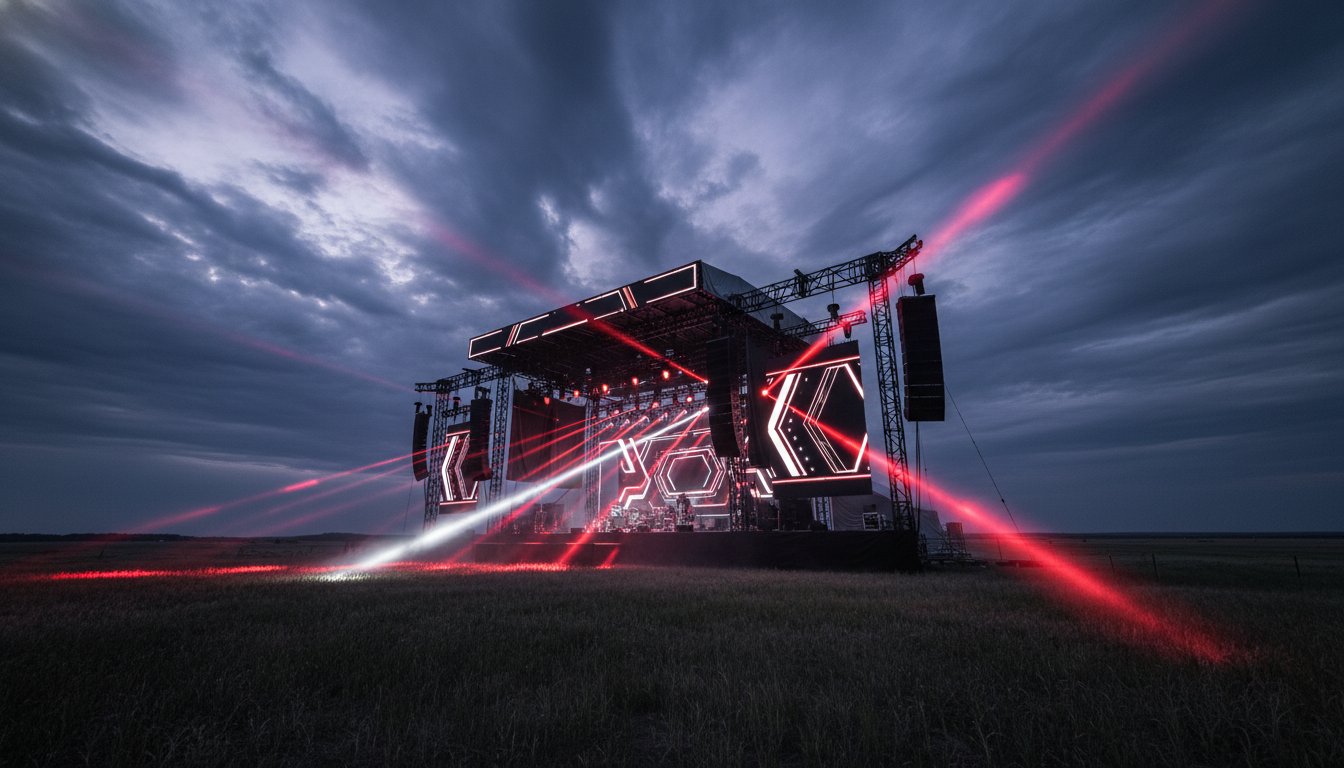
Western Canada's landscape requires a level of preparation that goes beyond standard indoor setups. When planning in Alberta or Saskatchewan, the environment becomes a primary technical variable. It isn't enough to have a high-resolution display; you need to know how that display behaves when the Chinook winds hit 80 kilometers per hour. Professional technical support for events in this region must account for environmental physics to ensure safety and continuity.
Wind load ratings are the most critical safety factor for outdoor productions. Mobile stages and large-scale LED walls act like giant sails. Professional teams calculate ballast requirements and structural limits weeks in advance. This engineering-first approach prevents catastrophic failures during sudden prairie storms. Additionally, remote locations often lack stable grid power. We prioritize "clean power" through regulated generators to protect sensitive digital gear from voltage sags and spikes that can crash a live stream or blow a sound console. Managing the logistics of a multi-city tour from Edmonton to Calgary and Regina requires a partner who understands these regional nuances.
Weather-Proofing Your Event Technology
Alberta is famous for extreme temperature shifts that can occur within a single afternoon. Rapid cooling causes condensation inside electronic components, while heat can trigger thermal shutdowns in high-output amplifiers. Our strategy involves using IP-rated (Ingress Protection) equipment for outdoor festivals to guard against moisture and dust. Dust is particularly aggressive in rural Saskatchewan; it can clog cooling fans and lead to hardware fatigue. We maintain our AV rentals with rigorous cleaning cycles to ensure reliability despite these harsh conditions.
Staging and Mobile Solutions
Mobile stage rentals provide a significant advantage for rapid deployment, especially in rural areas where traditional scaffolding is impractical. These units are self-contained and engineered for speed and safety. Effective technical support for events integrates these platforms with your audio-visual requirements from the start. For those planning in Central Alberta, our Red Deer corporate event AV resource offers specific insights into local venue logistics. Whether you are moving a tour through major hubs or small communities, consistent production management ensures the technical rider is met at every stop. To secure your regional production, contact our technical team today.
Choosing a Technical Partner: From Rental Shop to Production Management
Selecting a partner for technical support for events requires looking beyond the bottom line of a quote. A rental shop provides gear, but a production management firm provides certainty. You should look for absolute transparency in equipment lists and labor hours. A proposal that simply lists a generic "Audio Package" without specifying speaker models or wireless frequency management is a major red flag. Detailed documentation shows that the team has engineered a solution specifically for your venue and audience size. It demonstrates they understand the power requirements and signal paths necessary for a flawless show. When you see vague descriptions, it often means the provider is planning to "figure it out" on-site rather than engineering the solution in advance.
The value of a dedicated Project Manager cannot be overstated. This individual serves as your single point of contact, bridging the gap between your creative vision and the technical crew's execution. This role eliminates the stress of managing multiple vendors and ensures that the lighting, audio, and visual teams are working in a unified rhythm. Having a steady hand at the helm means you can focus on your stakeholders while the production management team handles the real-time logistics and troubleshooting. They are the ones who ensure the schedule stays on track and every transition between presenters is seamless. Without this central coordination, even the best equipment can't guarantee a successful outcome.
Evaluating Technical Competence
Ask prospective partners about their redundancy plans before signing any contract. What happens if the primary mixing console fails or a signal processor drops out? A professional team always has a "hot spare" or a secondary digital signal path ready to go. You should also verify their safety protocols and rigging certifications. High-stakes environments leave no room for guesswork or amateur setups. For a complete breakdown of what your production should include to meet industry standards, refer to our event production checklist. This guide covers every technical requirement from power distribution to signal flow, ensuring nothing is left to chance.
The Northern Signal AV Ltd. Difference
Northern Signal AV Ltd. represents a unique blend of technical elite mastery and community-focused accessibility. We don't just provide equipment; we act as a professional partner rooted in regional pride. Our localized reliability across Canada ensures that whether you're in a major urban center or a remote location, you receive the same high-energy, results-oriented service. We value performance and punctuality, positioning ourselves as the steady hand you need for high-stakes environments. Our mastery over technical support for events allows us to transform technical details into a seamless, transformative experience for your audience.
Ready to secure your production? Contact Northern Signal AV Ltd. for a technical consultation.
Elevate Your Next Production with Precision Engineering
Successful events occur when technical complexity is managed with such precision that it becomes invisible to the audience. We've explored how moving beyond simple gear rentals toward proactive production management mitigates the unique risks of Western Canada’s climate and logistics. By focusing on the core pillars of audio, visual, and lighting, you transform a standard meeting into a high-impact experience. Investing in expert technical support for events is ultimately about protecting your brand’s reputation through engineered reliability and a commitment to detail.
Northern Signal AV Ltd. stands as the steady hand required for these high-stakes environments. With 2026-ready LED wall technology and concert-grade audio systems, we provide the infrastructure needed for flawless delivery across Alberta and Saskatchewan. Our commitment to zero-fail redundancy and localized expertise ensures your vision is executed without compromise. It's time to leave the stress of technical uncertainty behind and partner with a team that values performance as much as you do. We invite you to experience the transformative power of a truly professional production.
Secure Flawless Technical Support for Your Next Event
Frequently Asked Questions
What is the difference between AV rental and technical support?
AV rental provides the physical hardware, while technical support provides the expertise to operate and manage that equipment. A rental shop gives you the tools; a technical team provides the engineering, troubleshooting, and production management to ensure those tools deliver a professional result. It's the difference between having the components of a sound system and having a professional engineer who ensures every seat has front-row audio clarity.
How many technical staff members do I need for a 500-person conference?
A standard 500-person conference typically requires a minimum of three to five specialized technicians. You'll need a front-of-house sound engineer, a video switcher for visual displays, and a dedicated technician for lighting or stage management. If your program includes complex hybrid elements or multiple presenters, a production manager is essential to coordinate the crew and keep the schedule on track.
Can technical support help with hybrid events and live streaming?
Yes, professional technical support for events includes the specialized infrastructure required for live streaming and hybrid events. Technicians manage the critical bridge between on-site audio systems and remote digital platforms to ensure low latency and high-quality signal flow. This involves multi-camera switching and professional encoding to keep virtual attendees as engaged as the audience physically present in the room. This technical precision is also vital for secondary content creation; for instance, you can explore Mobile Podcast Recording Sessions to capture high-fidelity interviews and discussions on-site.
What happens if the technology fails during my live presentation?
Professional teams deploy redundant systems to ensure zero-fail reliability during high-stakes moments. If a primary console or signal processor fails, a secondary digital path or "hot spare" is ready to take over immediately. Proactive monitoring identifies potential issues like thermal shifts or wireless signal interference before they disrupt your program, making any technical adjustments invisible to your audience.
Do I need to hire an external technical team if the venue has its own?
You should hire an external team if your event requires specialized gear or a custom brand experience that venue generalists cannot provide. External partners act as your dedicated advocate, bringing in concert-grade audio systems or high-resolution LED walls tailored specifically to your goals. Venue teams often prioritize durable, "one size fits all" equipment rather than the precision required for high-impact productions.
How far in advance should I book technical support for a large event?
You should book your technical partner at least three to six months in advance for large-scale events. This lead time is necessary for conducting detailed site surveys, reviewing technical riders, and engineering your custom audio and visual systems. Early booking is particularly important in Western Canada during peak seasons for corporate galas and outdoor festivals when specialized labor and equipment are in high demand.
What are the most common technical failures at corporate events?
The most frequent failures include wireless microphone interference, audio feedback, and visual signal dropouts during hybrid transitions. These issues usually stem from inadequate frequency coordination or poor power distribution. Professional technical support for events mitigates these risks through rigorous pre-event testing and the use of clean, regulated power systems that protect sensitive digital gear from voltage spikes and sags.
Does technical support include stage lighting and LED wall setup?
Yes, full-service technical support encompasses the design, setup, and operation of event lighting and LED wall systems. Technicians manage the complex DMX programming for dynamic lighting and the pixel mapping required for high-resolution displays. This ensures your staging looks professional both in person and on camera, providing the "energy" and focus needed to drive audience emotion throughout your program.