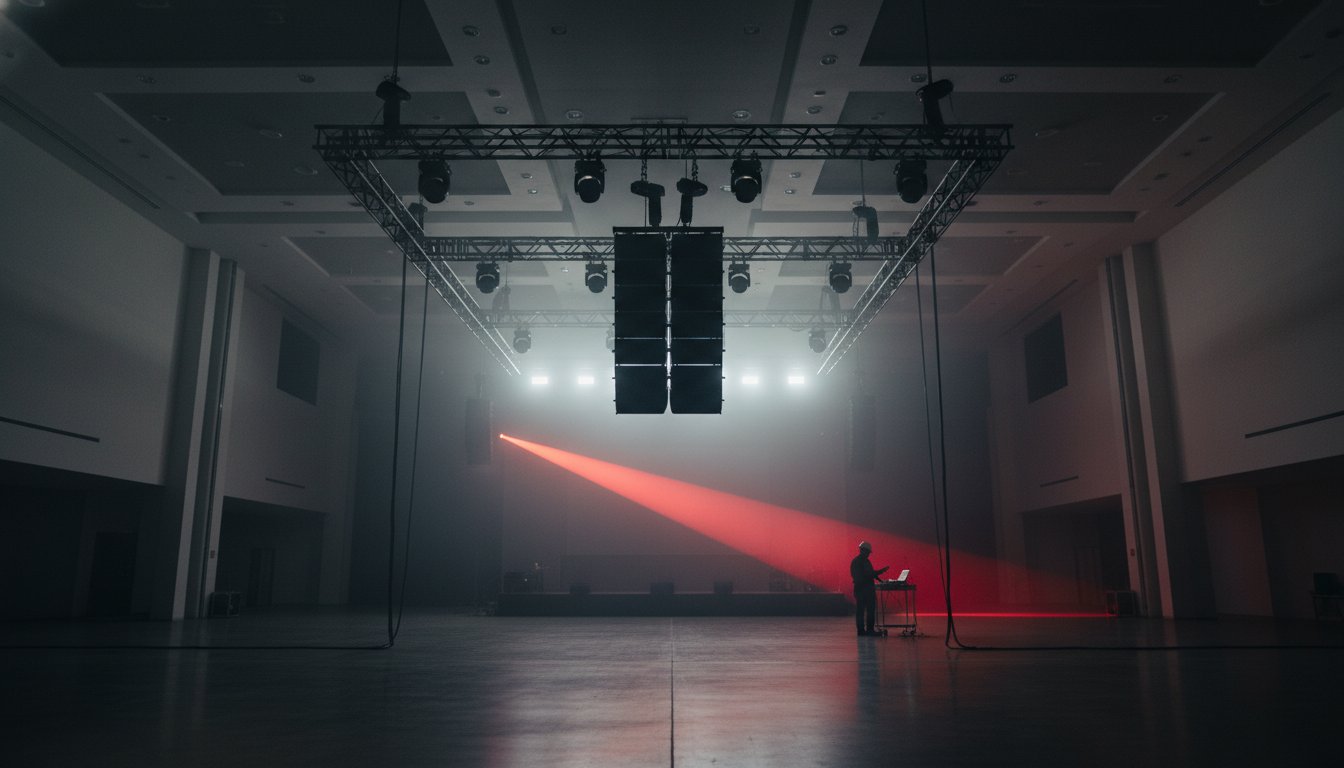
What if the difference between a standing ovation and a mass exit isn't your keynote speaker, but the 85-decibel threshold of your sound system? Many event planners in Alberta share a common fear of feedback loops and signal dropouts that ruin the audience's immersion. It's frustrating to deal with complex jargon like line arrays versus point source when you just need reliable results. As the global demand for professional audio systems continues to grow in 2026, the pressure to deliver studio-quality sound in a live environment has never been more intense.
You deserve a partner who views technical production as an art form rather than just a utility. This guide will help you master the essentials of sound engineering to ensure every attendee experiences crystal clear audio, regardless of the venue size. We'll explore how to leverage AI-powered optimization and seamless visual integration to keep your production running smoothly. From managing mid-size corporate AV budgets that typically range from C$1,500 to C$4,500 to meeting the latest OSHA safety standards, you'll gain the confidence to amplify every moment and illuminate every experience.
Key Takeaways
- Learn to distinguish between consumer PA gear and high-performance professional audio systems by prioritizing clarity and coverage metrics.
- Identify the ideal speaker architecture for your space, comparing the long-throw capabilities of line arrays with the precision of point source systems.
- Solve the "Dual Mix" challenge for hybrid events by balancing live room reinforcement with a dedicated, high-fidelity broadcast feed.
- Navigate technical planning for mid-sized Alberta venues by implementing acoustic echo cancellation to ensure seamless communication.
- Streamline your event lifecycle through professional production management that integrates technical design, setup, and strike.
What Defines Professional Audio Systems in 2026?
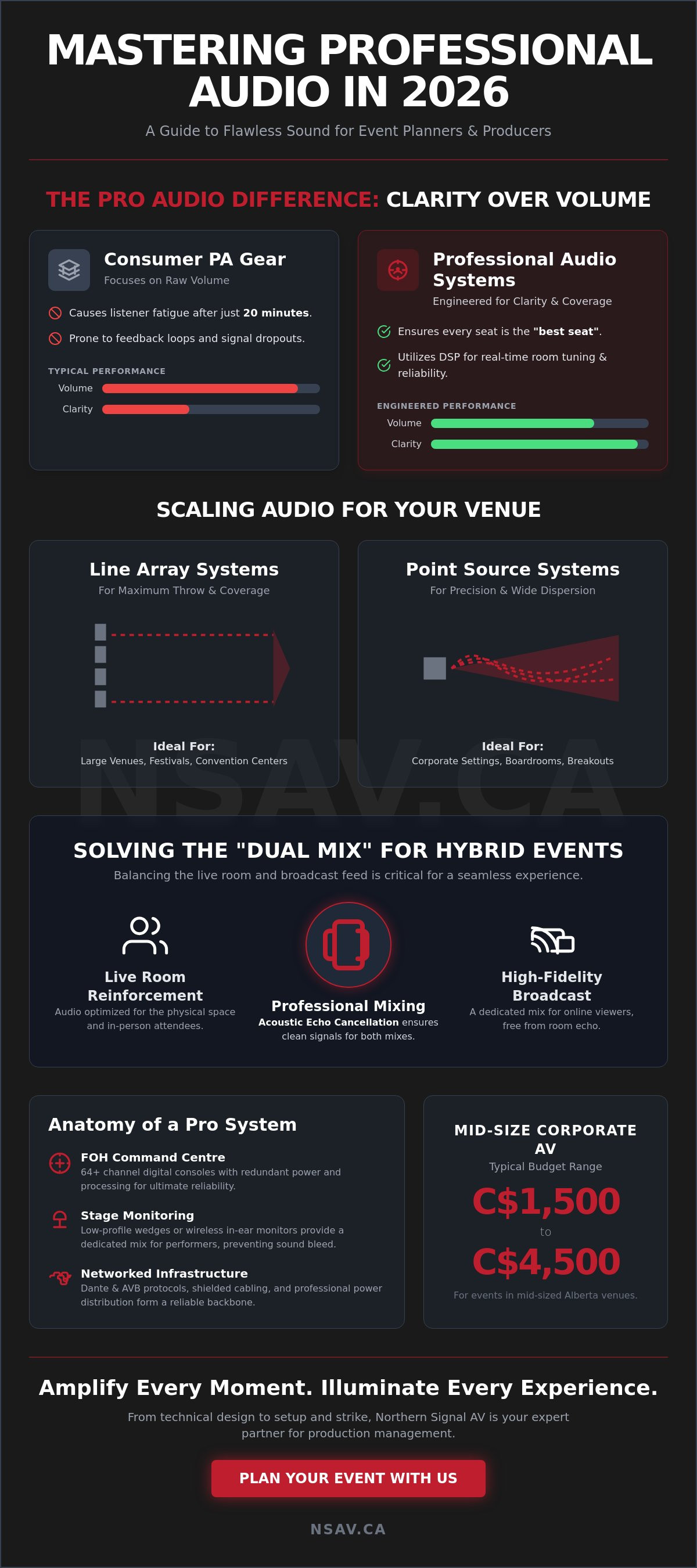
A professional audio system in 2026 is far more than a collection of speakers and microphones. It's a sophisticated ecosystem where engineering expertise and hardware work in tandem to create an immersive environment. While consumer-grade PA systems focus on raw volume, a true sound reinforcement system prioritizes clarity and uniform coverage. This means every attendee, whether they're in the front row or the back of a Calgary ballroom, receives the same high-fidelity experience. Modern professional audio systems rely on Digital Signal Processing (DSP) to analyze room acoustics in real time. This technology allows technicians to mitigate environmental hurdles like wind interference at outdoor events or the harsh echoes found in modern industrial venues across Alberta. It's the difference between a sound that merely fills a room and a sound that commands it.
Clarity vs. Volume: The Pro Audio Paradox
Many event planners mistake high volume for high quality. In reality, excessive acoustic pressure often leads to listener fatigue, causing guests to tune out after just 20 minutes of a presentation. Professional engineering focuses on high-frequency intelligibility, ensuring that consonants in a keynote speech are crisp and clear. This precision ensures the "best seat" isn't a specific location, but every square foot of the venue. By managing sound pressure levels (SPL) effectively, we protect the audience's hearing while amplifying the emotional impact of the message. Our approach ensures that your content is heard, not just tolerated.
System Integration: Beyond the Speakers
Reliability depends on the integrity of the entire signal chain, from the microphone diaphragm to the listener's ear. In 2026, the industry has shifted almost entirely toward networked audio protocols like Dante and AVB. These systems allow for massive scalability and reduced cable clutter, which is essential for complex production services. The unsung heroes of this chain are professional-grade power distribution and shielded cabling. These components prevent the interference and signal dropouts that plague amateur setups. Whether you're hosting a small rental pickup in Edmonton or a full-scale concert, the infrastructure behind the speakers defines the event's success. This networked approach also allows for seamless integration with visual displays and lighting, creating a unified technical backbone for any project.
Core Components of a High-Performance Audio Infrastructure
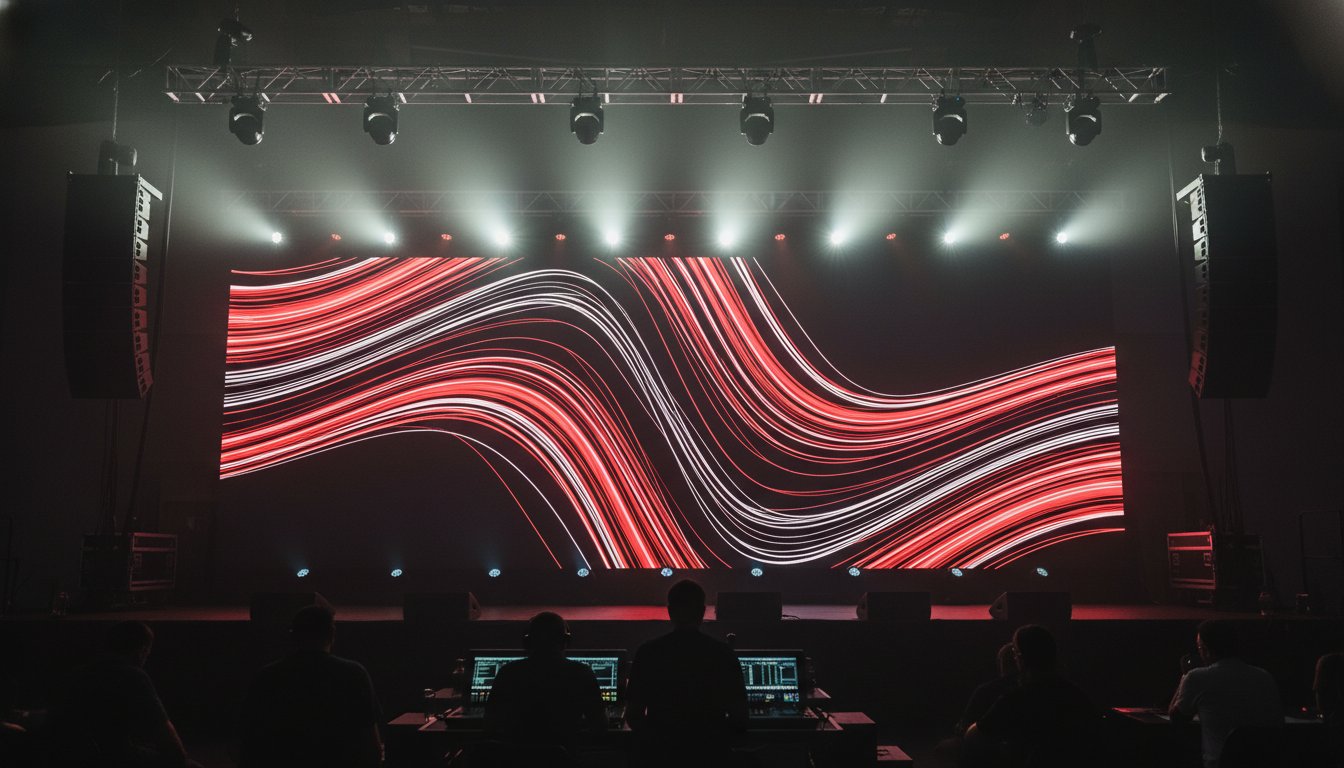
Constructing a resilient audio environment starts with selecting the right speaker architecture for the venue's physical layout. Modern professional audio systems generally fall into two categories: line arrays and point source systems. Line arrays excel in large-scale environments, like outdoor festivals or massive convention centers, because their vertical alignment allows sound to travel further with less volume loss. Conversely, point source speakers are the superior choice for intimate corporate settings or boardrooms in Calgary where wide horizontal coverage is prioritized over distance. Without the correct architecture, even the most expensive equipment will fail to deliver clear sound to every seat.
Stage monitoring is another critical component that event planners often overlook. If a presenter or performer can't hear themselves clearly, their delivery becomes hesitant and strained. We utilize low-profile floor wedges or wireless in-ear monitors to provide a dedicated mix for those on stage. This separation ensures that the "on-stage" sound doesn't bleed into the main audience area, maintaining the clarity established in our technical design. For those planning a multi-city tour across Alberta, our audio-visual rentals provide the consistency needed for these complex setups.
The Front-of-House (FOH) Command Centre
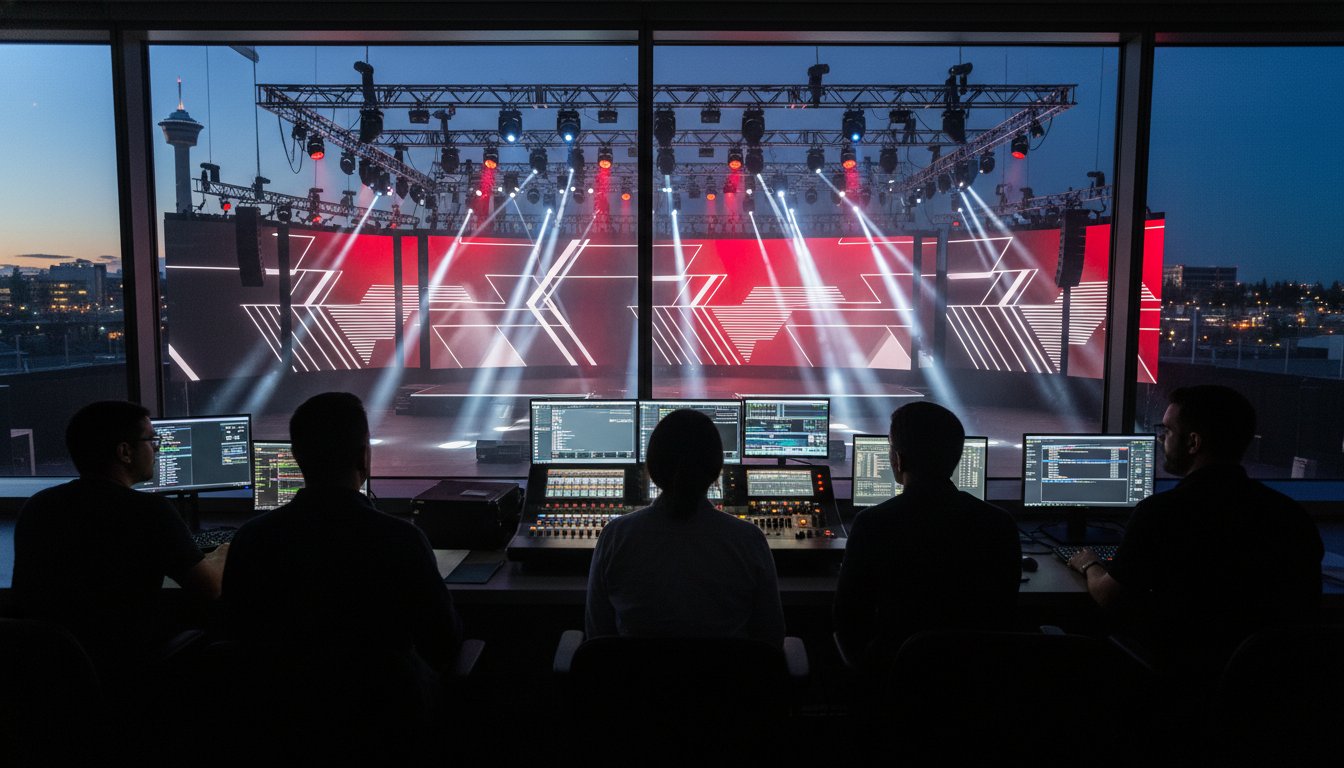
Front-of-House (FOH) serves as the central hub for all audio signal routing and processing. In 2026, digital mixing consoles have become the industry standard, with 64-channel configurations being the baseline for mid-to-large productions. A well-designed command center is the heart of high-performance professional audio systems, allowing for precision control over every nuance of the soundscape. We implement redundant processing engines and secondary power supplies to ensure the show continues even if a hardware failure occurs. This level of technical confidence is what separates a professional production from a standard rental.
Transducers and Microphones: Capturing the Source
The quality of your output is only as good as the initial capture. Choosing between lavalier, headworn, or handheld microphones depends entirely on the speaker's style and the venue's acoustics. Headworn microphones are often preferred for keynote speakers because they maintain a constant distance from the mouth, providing a stable signal. Managing radio frequencies (RF) is a significant hurdle in 2026, especially in the crowded wireless landscapes of downtown Edmonton or Calgary. As highlighted in the Pro Audio & Live Sound community, rigorous frequency coordination is mandatory to avoid interference from local cellular networks and other nearby events. Our technicians use specialized scanning software to carve out clean spectrum space for every wireless channel.
Scaling Audio Systems for Venue Size and Audience Reach
Scaling professional audio systems involves more than simply adding more speakers; it requires a precise understanding of venue acoustics and audience density. In intimate boardrooms or small rental spaces, the technical priority is often aesthetics and high-frequency speech clarity. In these environments, bulky equipment becomes a visual distraction. We utilize compact, high-output transducers that blend into the room's design while ensuring every syllable is captured with studio-like precision. Understanding What is Professional Audio? helps in realizing that even at a small scale, the goal is professional-grade fidelity rather than just increasing the volume. Every space has a "sweet spot," and our job is to expand that spot to cover every seat in the house.
Outdoor events in cities like Edmonton or Calgary introduce a different set of variables, such as a high ambient noise floor and unpredictable wind. Wind can actually "bend" high frequencies, causing the sound to seemingly drift away from the audience. We combat this by using high-density line arrays and steerable low-frequency arrays that maintain impact even in open-air environments. These systems are designed to cut through the noise of a busy downtown core or a windy festival ground, ensuring your message or performance remains the focal point. Our technical teams monitor local weather data in real time to adjust system tuning as atmospheric conditions change throughout the day.
Corporate Event Audio in Alberta: Ballroom Logistics
Many Alberta ballrooms feature low ceilings and highly reflective surfaces like glass or marble. These architectural choices create acoustic reflections that can muddy the sound and reduce intelligibility. To solve this, we deploy delay speakers throughout the room. This strategy ensures the audio arrives at the back of the room at the same time as the visual signal, maintaining perfect synchronization. When integrating audio visual rentals with existing venue infrastructure, we often manage multi-room breakouts and overflow feeds. This ensures that a keynote delivered in the main hall is transmitted with zero latency to attendees in secondary spaces, keeping the entire event connected.
The Stadium & Festival Rig: Engineering for Power
For large-scale concerts and stadium events, the engineering focus shifts to "throw" distances and sub-bass impact. We calculate the exact angle of every speaker element in a massive line array to ensure sound reaches the furthest attendee without losing energy. The use of mobile stage rentals is a critical part of this acoustic planning, as they provide a stable, engineered platform for heavy audio arrays. Safety protocols are paramount when rigging these systems in public spaces. We strictly adhere to load-bearing limits and wind-speed thresholds, utilizing secondary safety steels to protect both the audience and the hardware. This rigorous approach ensures that the power of the performance is never compromised by technical or safety limitations.
This level of commitment to precision and safety in rigging mirrors the exacting standards required in other technical sectors, such as the industrial weighing and calibration expertise offered by Independent Scale Service.
Technical Planning: Ensuring Reliability for Hybrid Events
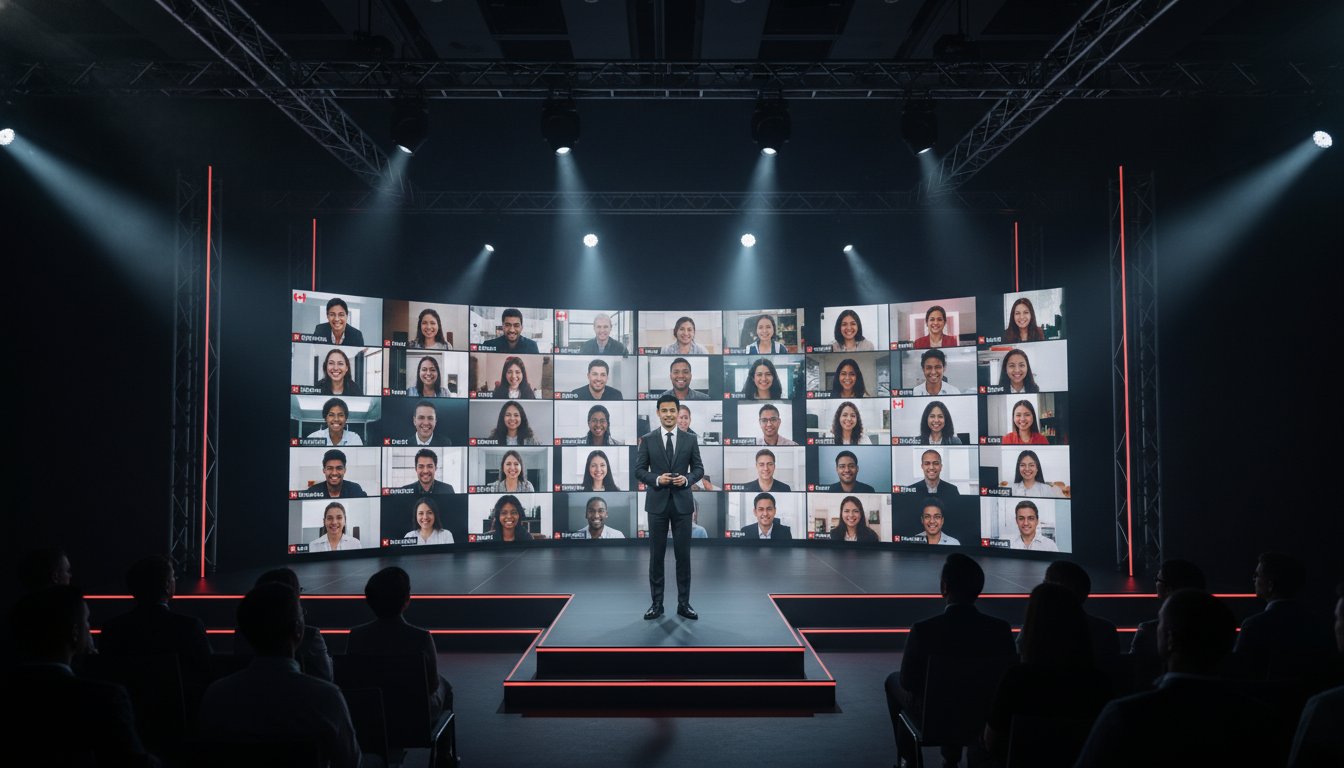
Hybrid events in 2026 demand a split personality from professional audio systems. You aren't just mixing for the people in the room; you're producing a live broadcast simultaneously. The "Dual Mix" challenge requires balancing a high-energy in-room experience with a clean, compressed feed for virtual attendees. Without specialized engineering, the remote audience often feels like an afterthought, struggling with muffled voices or jarring volume shifts. Reliability in this high-stakes environment depends on redundant internet paths, such as dedicated fiber paired with low-latency satellite backups, and uninterruptible power supplies (UPS) to prevent a single point of failure from silencing the stream. This technical confidence allows your message to reach every attendee, whether they're in a Calgary ballroom or watching from another continent.
The Hybrid Audio Workflow
Using separate "busses" on a digital console is the standard way our production services manage these two distinct audiences. This configuration allows us to apply specific processing to the broadcast feed without affecting the live reinforcement in the venue. We also carefully monitor the "return feed" to ensure that the voices of remote speakers don't loop back into the room's microphones, which creates a disruptive echo. By implementing hardware-based Acoustic Echo Cancellation (AEC), we ensure that conversation flows naturally between Edmonton-based presenters and remote guests. This master of the technical details alleviates the stress of event planning and ensures a seamless experience for all participants.
Audience Engagement Through Sound
Engagement for virtual attendees depends heavily on the psychological connection created by high-quality audio. If remote viewers can't hear the audience's laughter or applause, they feel isolated from the live experience. We use dedicated room microphones to capture the atmosphere of the venue, mixing it subtly into the broadcast feed to bridge the gap between physical and digital spaces. This attention to detail is vital because, in 2026, 70% of event failures are attributed to audio-sync issues in hybrid environments. When the sound doesn't match the speaker's lips, audience retention drops by nearly half within the first ten minutes. To avoid these technical pitfalls and ensure your event's impact, you can contact our expert team to design a resilient professional audio systems strategy for your next project.
Expert Production: Why Northern Signal AV is Your Technical Partner
Hardware manufacturers often claim that buying high-fidelity equipment is the only step to success. This ignores the reality of live events. A professional audio system requires a "Service-as-a-System" approach, where engineering expertise is just as critical as the hardware itself. Northern Signal AV Ltd. acts as your steady hand in these high-stakes environments, providing end-to-end production management. We manage every detail from the initial technical design to the final equipment strike. This comprehensive oversight ensures your focus remains on your audience while we handle the complexities of signal flow and acoustic optimization.
Our versatility is a core part of our identity. We're humble enough to support a small equipment pickup but sophisticated enough to lead a full-scale concert production. This range allows us to scale our solutions precisely to your needs. Whether you're hosting a 50-person corporate briefing or a 5,000-person outdoor festival, the technical precision remains the same. By treating every project as a partnership, we alleviate the stress of event planning and project a sense of mastery over the technical details that define your event's reputation.
Comprehensive AV Solutions in Alberta and Ontario
Our deep roots in the Alberta market provide a level of localized reliability that national competitors often lack. Whether you need Calgary event production or a complex setup in Edmonton, our team understands the specific regional logistics and venue requirements of Western Canada. We offer a single point of contact for your audio, lighting, and LED walls. This integration simplifies communication and ensures all technical elements work in harmony. Our technical support team doesn't just react to problems; we pre-empt failures by conducting rigorous stress tests on all professional audio systems before they arrive at your venue. This proactive approach ensures a frictionless experience from load-in to load-out.
Book Your Technical Consultation
Success is built during the planning phase, not on the day of the show. We prioritize early-stage technical walkthroughs at your venue to identify potential acoustic hurdles or power limitations before they become event-day crises. Every quote we provide is customized to reflect your specific audience size and engagement goals. We're committed to our core mission: amplifying moments and illuminating experiences. This is the Northern Signal AV Ltd. standard of excellence. Ready to elevate your sound? Contact Northern Signal AV Ltd. today for a professional assessment and let our experts design a resilient technical strategy for your next project.
Master the Future of Live Sound
Mastering the technical landscape of 2026 requires more than just high-volume hardware. It's about implementing a "Service-as-a-System" model where engineering mastery ensures flawless execution from the first sound check to the final strike. You now understand how to navigate the "Dual Mix" challenge for hybrid audiences and how to scale speaker architecture for Alberta's diverse venue layouts. Modern professional audio systems thrive on this level of precision, turning potential technical glitches into seamless opportunities for audience engagement. Whether you're managing acoustic reflections in a Calgary ballroom or battling the wind at an outdoor festival, the right technical strategy remains your most valuable asset.
Northern Signal AV Ltd. provides expert technical production management for events of all sizes across Edmonton, Calgary, and Saskatchewan. Our comprehensive inventory, featuring high-definition LED walls and mobile stages, is designed to amplify every moment and illuminate every experience. Don't let technical complexity hinder your creative vision or stress your planning process. Elevate Your Event with Professional AV Production and partner with a team that prioritizes reliability and performance. Your next successful event is just one expert consultation away.
Frequently Asked Questions
What is the difference between a PA system and a professional audio system?
A professional audio system focuses on clarity and uniform coverage through digital signal processing (DSP) rather than just raw volume. While a basic PA system might only amplify a single source, professional systems use a networked infrastructure to tune the sound specifically for the room's unique acoustics. This ensures that every attendee receives the same high-fidelity experience regardless of where they are seated in the venue.
How much does it cost to rent a professional audio system for a corporate event?
Most mid-size corporate events in Canada see AV production costs ranging between C$1,500 and C$4,500 according to 2026 industry benchmarks. These figures vary based on the number of wireless channels, the complexity of the speaker architecture, and the required hours of technical support. For a precise estimate that reflects your specific audience goals and venue logistics, a custom consultation is the most reliable approach.
Do I need a sound engineer if I rent professional audio equipment?
Yes, having a sound engineer is critical for managing real-time mixing and frequency coordination during high-stakes events. They act as a steady hand to monitor signal levels and prevent technical glitches like signal dropouts or feedback. Their expertise in professional audio systems allows them to adjust the mix instantly if a speaker's volume changes or if environmental noise increases unexpectedly.
What is a line array, and when should I use one over a standard speaker?
A line array is a series of speakers aligned vertically to project sound over long distances with minimal volume loss. You should choose a line array for large-scale environments like outdoor festivals or massive convention centers where "throw" distance is essential. Standard point source speakers are more effective for intimate Calgary boardrooms where wide horizontal coverage and a smaller visual footprint are the primary requirements.
Can professional audio systems be used outdoors in Canadian winter conditions?
Professional gear can operate in extreme cold if it stays within the manufacturer's specified temperature range, which often reaches -20°C for ruggedized components. Technicians manage these Alberta winter conditions by using climate-controlled racks and specialized enclosures to prevent internal condensation. Keeping the equipment powered on throughout the event helps maintain a stable internal temperature and ensures the electronics remain responsive despite the external environment.
How do I prevent microphone feedback during a live presentation?
Prevent feedback by ensuring speakers are positioned well in front of the microphone's pickup pattern to avoid a signal loop. Our engineers also "ring out" the room during the technical setup to identify and neutralize problematic frequencies before the audience arrives. Using directional microphones and automated feedback suppression software provides an additional layer of reliability for presenters who move around the stage during their keynote.
What audio equipment is needed for a 500-person conference in Edmonton?
A 500-person conference typically requires a digital mixing console, at least four wireless microphone channels, and a distributed speaker system. If the Edmonton venue is deep, we implement delay speakers to maintain speech intelligibility for the back rows without overwhelming the front of the room. This setup ensures a consistent acoustic experience and allows for seamless integration with recording or live-streaming feeds for remote participants.
How does professional audio integrate with LED walls and event lighting?
Audio integrates with visual elements through networked protocols that synchronize sound cues with lighting transitions or video playback. This unified technical backbone allows a single trigger to amplify a moment and illuminate an experience at the exact same millisecond. By using a single provider for professional audio systems and visual displays, you eliminate the risk of sync issues that often plague fragmented technical teams.