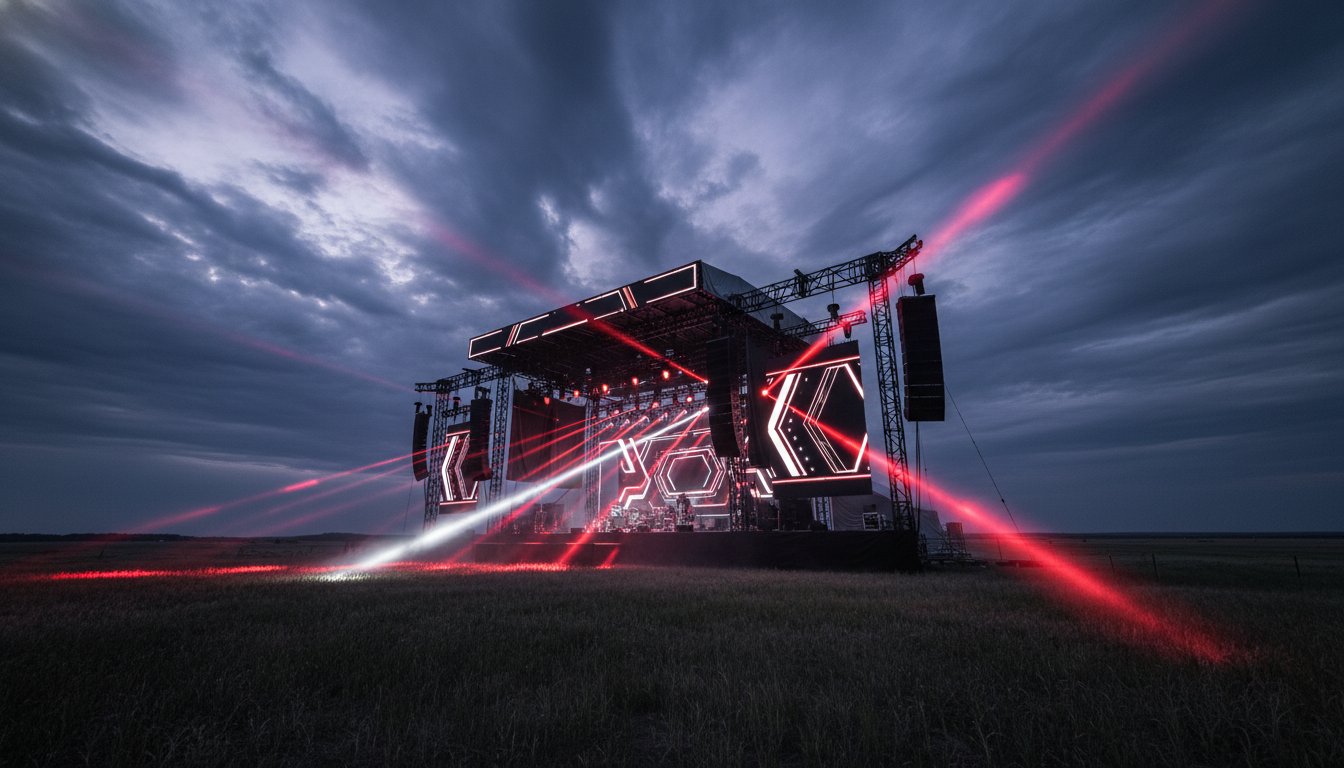
Your high-definition LED wall won't matter if a 90 km/h Chinook gust turns your event platform into a safety liability. In the unpredictable climate of the prairies, a mobile stage rental alberta isn't just a floor for your performers; it's a piece of precision engineering that must withstand the elements while supporting tons of audio-visual gear. You've likely felt the stress of coordinating rural logistics or worrying if your setup meets the latest National Building Code (Alberta Edition) standards. It's a high-stakes environment where there is no room for technical failure.
We understand that event professionals need more than just equipment. You need a turn-key solution that integrates seamlessly with your lighting and sound systems to create a transformative experience. This 2026 guide promises to walk you through the technical, logistical, and safety requirements to ensure your next production is flawlessly executed. We'll preview critical permit timelines, such as Calgary's 45-day application window, and explain how to select a stage with the rigging capacity to handle your entire technical rider without compromise.
Key Takeaways
- Master National Building Code (NBC) compliance and ensure your structure meets mandatory 120+ km/h wind resistance ratings for the Alberta climate.
- Identify the precise stage size for your event, from compact units for 1,000 guests to large-scale festival platforms like the SL100.
- Manage the logistics of mobile stage rental alberta by coordinating permit applications and site stability assessments across Calgary, Edmonton, and Red Deer.
- Optimize your technical setup by learning how to rig concert lighting and LED walls directly onto hydraulic stage points for a seamless production.
- Reduce vendor friction by adopting a turn-key staging solution that integrates professional audio and visual systems from the ground up.
The Shift to Mobile: Why Alberta Event Planners Choose Portable Staging
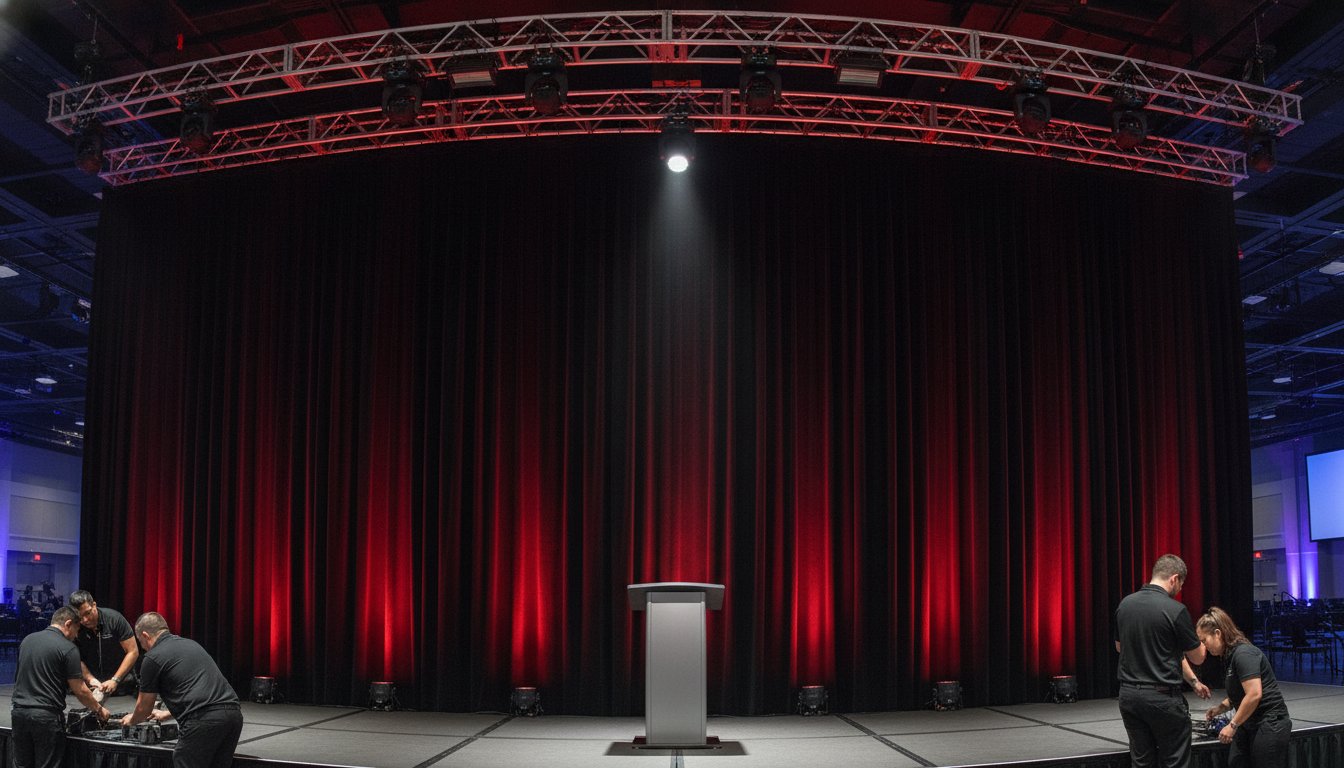
Modern event production has evolved beyond the era of manual scaffolding and modular decks that take days to assemble. Securing a mobile stage rental alberta has become the standard for professionals moving away from the slow, manual labor of the past. These units are built on hydraulically expanding trailer systems. They arrive as a compact trailer and transform into a massive, professional performance space in a fraction of the time required by traditional methods. While historical types of staging often involved "stick-built" scaffolding that required large crews and heavy machinery, the 2026 mobile model is a self-contained engineering marvel.
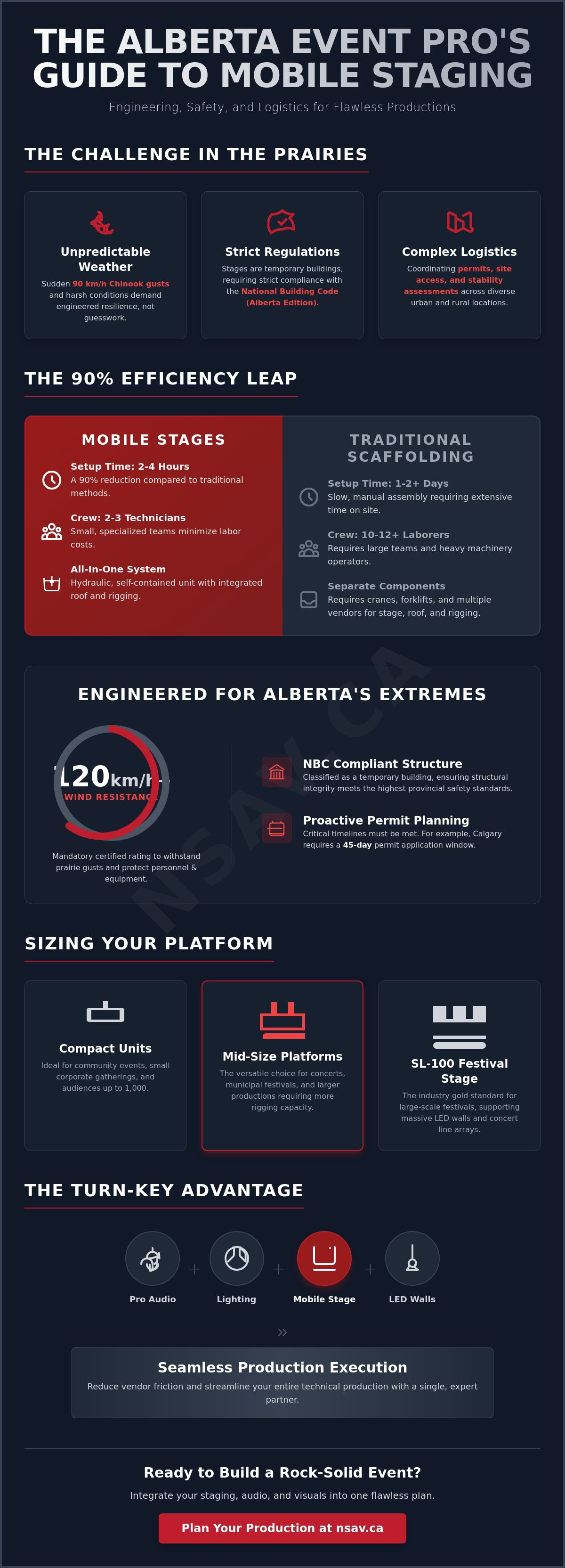
The primary driver for this shift is efficiency. A mobile stage offers a 90% reduction in setup time compared to traditional scaffolding. What once took a full day and a dozen technicians now takes a small crew just a few hours. This speed significantly lowers labor costs, allowing organizers to allocate their budget toward high-impact elements like LED walls and concert lighting. The built-in roof system also removes the need for separate rigging structures, providing a "Covered Stage" advantage that ensures the show continues regardless of the forecast.
Reliability in the Alberta Climate
Alberta's weather is notoriously fickle. Sudden wind gusts and heavy rain can turn a standard outdoor setup into a high-risk environment in minutes. Traditional scaffolding stages often struggle with wind resistance because their "skin" or windwalls act like sails. Mobile stages are different. They are pre-engineered, heavy-duty structures designed to withstand high winds while protecting your expensive AV gear. Having a roofed environment already in place allows for a "show-and-go" schedule; your technical team can load in audio and lighting immediately after the stage unfolds, without waiting for a separate roofing crew to finish their work.
Cost-Efficiency and Logistics
Logistics in major hubs like Edmonton and Calgary require a streamlined approach to minimize on-site footprints. Mobile stages don't require the same heavy machinery, such as cranes or multiple forklifts, that traditional builds demand. This makes them the preferred choice for urban festivals where space is at a premium and rural events where bringing in extra equipment is cost-prohibitive. By choosing a mobile solution, you're opting for a versatile platform that integrates perfectly with NSAV Production Services. This synergy between the stage structure and the technical production ensures that your power, rigging, and sightlines are all managed under a single, cohesive plan. It's a professional partnership that prioritizes performance and punctuality over the chaos of managing multiple staging vendors.
Technical Standards: Engineering and Safety for Alberta Events
Technical excellence isn't optional for a mobile stage rental alberta. It's a legal mandate. The National Building Code (Alberta Edition) classifies these stages as temporary buildings. This means your setup must comply with the same structural logic as a permanent facility. Aligning with Events Industry Council International Standards ensures your site management meets global benchmarks for safety and site management. When you're hosting thousands of attendees, "close enough" doesn't cut it for structural integrity.
Alberta's geography creates unique wind tunnels, especially near the Rockies and across the open prairies. A professional stage must have a certified wind tolerance of at least 120 km/h. Mobile stages achieve this through integrated hydraulic systems that do more than just speed up the build. These systems lock the roof and floor into a rigid, singular unit. This combined mass provides the stability needed to protect performers and thousands of dollars in sensitive technical equipment from sudden gusts.
Stageline: The Industry Gold Standard
Stageline's SL-series is the benchmark for the Alberta festival circuit. These units offer massive load-bearing capacities for hanging heavy line arrays and high-resolution LED walls without requiring external ballast. The precision of their hydraulic leveling systems ensures a perfectly flat deck on uneven Alberta terrain, regardless of ground slope or soil density. This technical mastery allows you to focus on the creative impact of your event rather than structural risks. It's the difference between a shaky platform and a rock-solid performance space.
Liability and Insurance Requirements
Professional staging providers must offer more than just hardware. They need to provide stamped engineering drawings for municipal permits in cities like Calgary or Red Deer. Without these documents, your event could be shut down by a fire marshal or building inspector on the morning of the show. Ensure your partner carries comprehensive professional liability insurance that covers both the equipment and the onsite crew. By choosing expert production management, you transfer the burden of technical safety to a team that understands these rigors. If you're planning a complex outdoor build, it's wise to consult with a technical partner early in the planning phase to ensure every safety check is documented and verified.
Sizing Your Stage: Choosing the Right Model for Your Audience
When selecting a mobile stage rental alberta, the first step is matching the technical footprint to your specific audience density. A stage that is too small limits your production value; one that is too large unnecessarily inflates your budget. For small-scale events hosting up to 1,000 people, the Stageline SL75 is often the ideal choice. It offers a professional, covered performance area without overwhelming a compact urban site or a smaller community park. It's the perfect entry point for organizers who need a steady hand and a reliable platform for local talent.
Mid-range festivals, typically seeing 1,000 to 3,000 attendees, require the versatility of the SL100. This model is the industry workhorse for regional Alberta events, striking a perfect balance between rigging capacity and setup speed. For large-scale concerts and major touring acts exceeding 5,000 guests, the scale shifts to the SL250 or SL320 models. These massive units support significant weight loads for heavy audio arrays and complex visual displays. If your performance involves a large orchestra, a 12-piece band, or elaborate set pieces, deck extensions can be added to customize the floor space. This provides the necessary depth for complex choreography and ensures your technical team has room to maneuver safely backstage.
Audience Sightlines and Height Requirements
In the flat expanses of Alberta's parks and fields, deck height is the primary factor for visibility. If your stage is too low, the first few rows of the crowd will block the view for everyone else. A higher roof doesn't just look impressive; it provides the vertical clearance needed for sophisticated lighting rigs to reach the back of the audience. For crowds spread across a wide area, integrating LED wall rentals is the most effective way to ensure every attendee has a front-row experience. These displays help bridge the gap between the performer and the back of the field, maintaining high engagement levels throughout the show.
Access and ADA Compliance
Professionalism extends to how performers and staff interact with the space. Accessibility is a requirement, not an option. Your setup must include engineered ramps and stairs that comply with modern accessibility standards to ensure every performer can reach the deck safely. Beyond the stage itself, consider the logistics of loading docks and backstage areas for equipment transitions. For a complete overview of these requirements, refer to our Outdoor Concert Stage Rental Checklist to ensure no detail is overlooked during your site planning phase.
Logistics and Site Preparation in Alberta and Saskatchewan
Executing a successful mobile stage rental alberta requires meticulous planning long before the trailer leaves the warehouse. Site access is the first hurdle. These units are heavy, trailer-mounted structures that require significant turning radii for the towing vehicles. You must ensure the path to the setup location is clear of tight corners and narrow gates. Ground stability is equally critical. A mobile stage exerts immense pressure on its leveling jacks; if the ground is soft from recent rain or consists of uncompacted soil, the structure's integrity is at risk. We prioritize assessing these physical constraints to ensure a steady hand during the high-stakes setup phase.
Permitting is another layer of the logistical puzzle that varies by municipality. In Calgary, for instance, you must submit a building permit application at least 45 days before your event date. Edmonton and Red Deer have their own specific timelines and fire code requirements for temporary structures. Power logistics also demand early attention. While the stage's hydraulic systems are self-contained, the integrated audio and lighting systems usually require dedicated whisper-quiet generators. If you're planning a rural event in remote Saskatchewan or Northern Ontario, self-sufficiency is your only option. You need to account for the increased travel time and the lack of immediate local technical support by choosing a partner with a proven track record in remote production management.
The 2026 Weather Management Plan
Weather management in the prairies is a matter of professional survival. Your technical team must utilize real-time wind monitoring protocols throughout the duration of the show. Modern mobile stages allow for emergency procedures that can lower the roof or secure windwalls in minutes if conditions deteriorate. Implementing a formal "weather-stop" protocol is a non-negotiable requirement for Alberta festivals to ensure attendee safety when local wind speeds exceed certified thresholds. This proactive approach alleviates stress and ensures a solution-oriented response to shifting atmospheric conditions.
Site Survey and Ground Conditions
A comprehensive site survey is the only way to avoid day-of-show disasters. You must check for underground utilities like gas lines or irrigation systems before any weight is distributed. Overhead obstructions, such as low-hanging power lines or tree branches, can also prevent the stage roof from fully extending. Whether you're setting up on the manicured grass of a city park, a gravel lot, or urban asphalt, each surface requires specific cribbing and protection strategies. Leveraging Calgary event production expertise early in your planning allows you to identify these obstacles before they become expensive problems. If you need a technical partner to evaluate your site and manage these complex logistics, contact our team today to start your consultation.
The Full Production Advantage: Integrating AV, Lighting, and LED
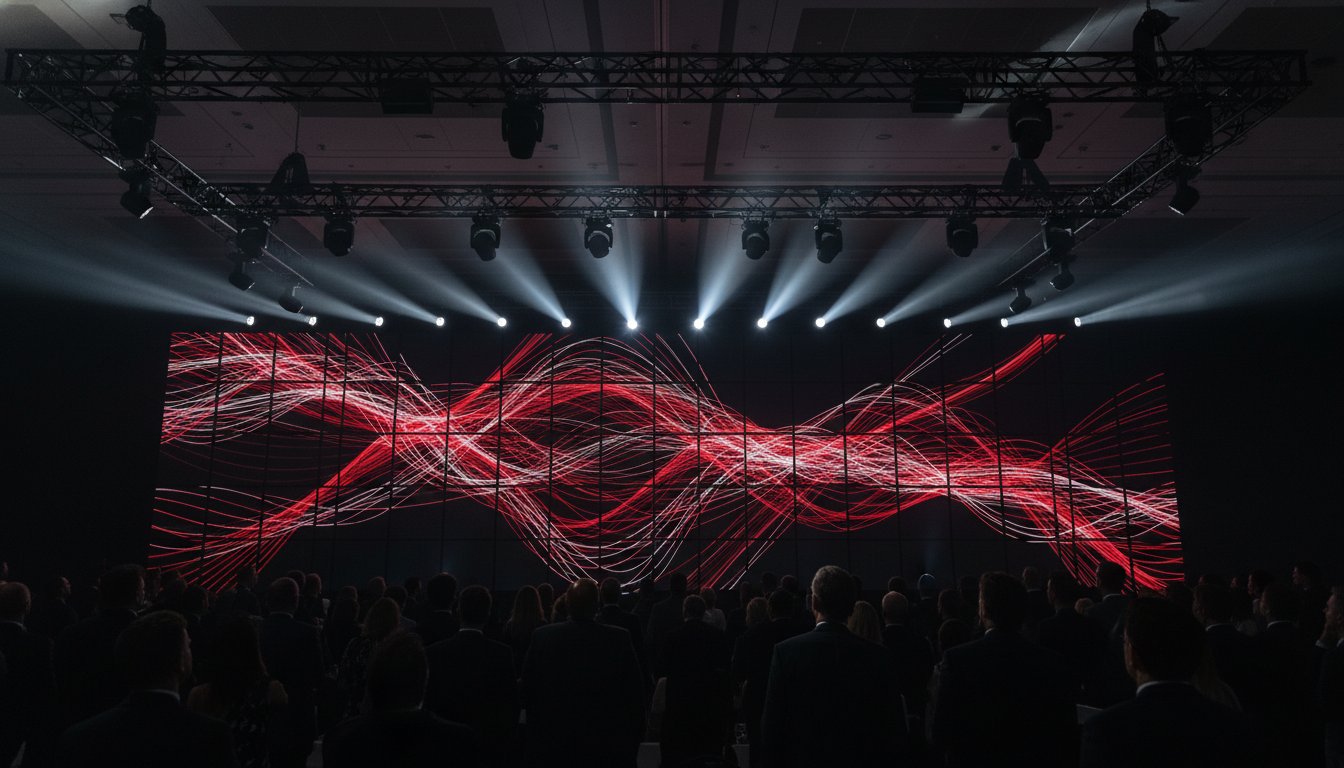
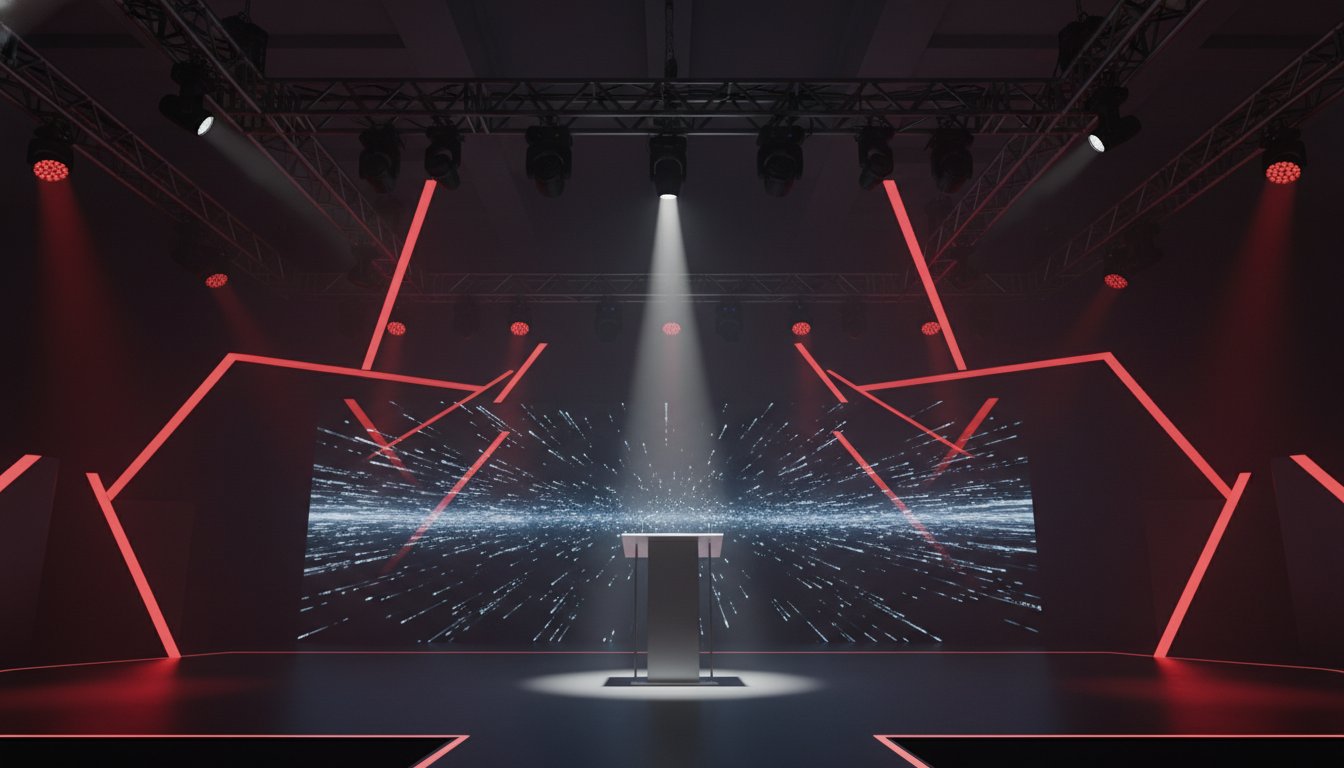
A mobile stage rental alberta serves as the structural foundation for your entire technical production. It's not merely a platform for performers; it's a specialized rigging environment designed to support the weight of high-resolution LED walls and complex lighting plots. Choosing a mobile unit over traditional scaffolding provides you with certified hang points that are integrated into the roof's engineering. This allows your technical team to deploy massive visual displays and heavy line arrays with absolute confidence in the structure's load-bearing capacity. When your stage is built to these standards, it becomes the backbone of a Professional Audio System, ensuring every speaker and fixture is positioned for maximum impact.
Mastering the "Stage-AV-Lighting" trifecta requires a cohesive approach to technical support. Instead of managing three different vendors who might disagree on rigging priorities, a unified production strategy ensures every piece of equipment works in harmony. This integration eliminates on-site friction and ensures your power distribution, signal paths, and weight loads are calculated as a single, safe system. It's a professional partnership that transforms a simple trailer into a world-class concert environment.
Concert Audio and Lighting Integration
Designing effective audio coverage starts at the stage and moves outward. By utilizing the integrated rigging points of a mobile stage, technicians can fly line arrays at the precise height and angle needed to cover the entire audience area without obstructing sightlines. Subwoofers can be arrayed along the front of the deck to provide a consistent low-end punch across the field. Coordinating your lighting cues with the stage's structural rigging allows for a dynamic visual show that feels intentional and polished. This single-source approach reduces technical friction, ensuring your lighting and sound teams aren't competing for the same limited space or power circuits.
Branding Your Stage
A mobile stage offers significant real estate for sponsor visibility and event branding. You can utilize custom mesh banners and specialized roof headers to transform the industrial look of a trailer into a tailored marketing asset. These banners are designed to allow wind to pass through safely while maintaining high-impact graphics. For the areas behind the scenes, using Pipe and Drape creates a professional backstage environment and "green room" feel for your performers. This attention to detail elevates the perception of your event from a basic community gathering to a high-end production. To ensure your next event is professional and flawlessly executed, Contact Northern Signal AV Ltd. for a comprehensive mobile stage and production quote.
Elevate Your Next Alberta Production with Precision Engineering
Successful events in the prairies demand more than just a platform. They require a foundation that balances structural safety with high-end technical performance. By prioritizing National Building Code compliance and certified wind resistance, you protect your investment against the region’s unpredictable elements. Integrating your mobile stage rental alberta with professional audio systems and high-resolution LED walls ensures a transformative experience for your audience while reducing the friction of managing multiple vendors.
As professional audio-visual production specialists serving Alberta, Saskatchewan, and Ontario, we provide the expert technical support and production management needed to turn complex logistics into a seamless show. Our team is ready to help you navigate permit timelines and site-specific challenges to ensure your vision is executed without compromise. Get a Professional Mobile Stage & AV Quote for Your 2026 Event and let's build something extraordinary together.
Frequently Asked Questions
How much does it cost to rent a mobile stage in Alberta for 2026?
Rental costs for a mobile stage rental alberta vary based on the model size, rental duration, and delivery distance. While smaller modular decks are available for entry-level needs, full-scale trailer-mounted stages are quoted individually to account for specific technical requirements and site logistics. We provide detailed, transparent quotes that reflect the complexity of your setup and the specific equipment required for a professional result.
How long does it take to set up a mobile stage like the Stageline SL75?
A professional mobile stage like the SL75 can be fully deployed in approximately 60 to 90 minutes. This represents a significant time saving over traditional scaffolding systems that often require a full day or more. While the structural setup is fast, you should still budget several additional hours for the integration of sound, lighting, and visual displays to ensure a polished performance.
What kind of wind speeds can a professional mobile stage handle?
Professional mobile stages are engineered for extreme durability, with models like the SL75 capable of withstanding winds up to 185 km/h (115 mph). This rating often applies even without windwalls in place. For any mobile stage rental alberta, we monitor local weather patterns in real-time to ensure the safety of all performers and attendees during high-wind events and sudden Chinook gusts.
Do I need a special permit to have a mobile stage at my event in Calgary or Edmonton?
Yes, temporary stages are classified as buildings under the National Building Code (Alberta Edition) and require municipal permits. For events in Calgary, you must submit your building permit application at least 45 days in advance. Our team assists with the necessary engineering drawings to help you navigate these regulatory requirements in Edmonton and surrounding municipalities without unnecessary stress.
Can I hang an LED wall or heavy speakers from the roof of a mobile stage?
You can absolutely hang heavy LED walls and concert audio systems from the integrated rigging points. For example, the SL75 has a certified rigging capacity of 4,250 lbs. This allows for the safe suspension of high-resolution displays and line arrays without the need for external support towers or additional ballasts, creating a cleaner and safer stage environment.
What are the power requirements for a mobile stage and AV setup?
While the stage's hydraulic deployment system is self-contained, your audio and lighting production will require a dedicated power source. We typically integrate whisper-quiet generators to handle the heavy electrical load of professional AV systems. This ensures a stable power supply even in rural locations where local grid access is unavailable or insufficient for high-end production gear.
Are mobile stages safe for performers in heavy rain?
Mobile stages are specifically designed to provide a weather-resistant environment for performers and gear. The pre-installed roof system offers immediate protection from rain, allowing the show to continue in most conditions. We always maintain a strict "weather-stop" protocol to address severe electrical storms or wind speeds that exceed the manufacturer's safe operating limits to prioritize performer safety.
Does Northern Signal AV Ltd. provide staging in Saskatchewan and Ontario as well?
Yes, we provide full production management and staging services across Alberta, Saskatchewan, and Ontario. Whether you're hosting a festival in a remote northern town or a corporate event in a major urban center, our team manages the complex logistics to ensure a professional and punctual setup. We pride ourselves on being a steady hand for high-stakes regional events.