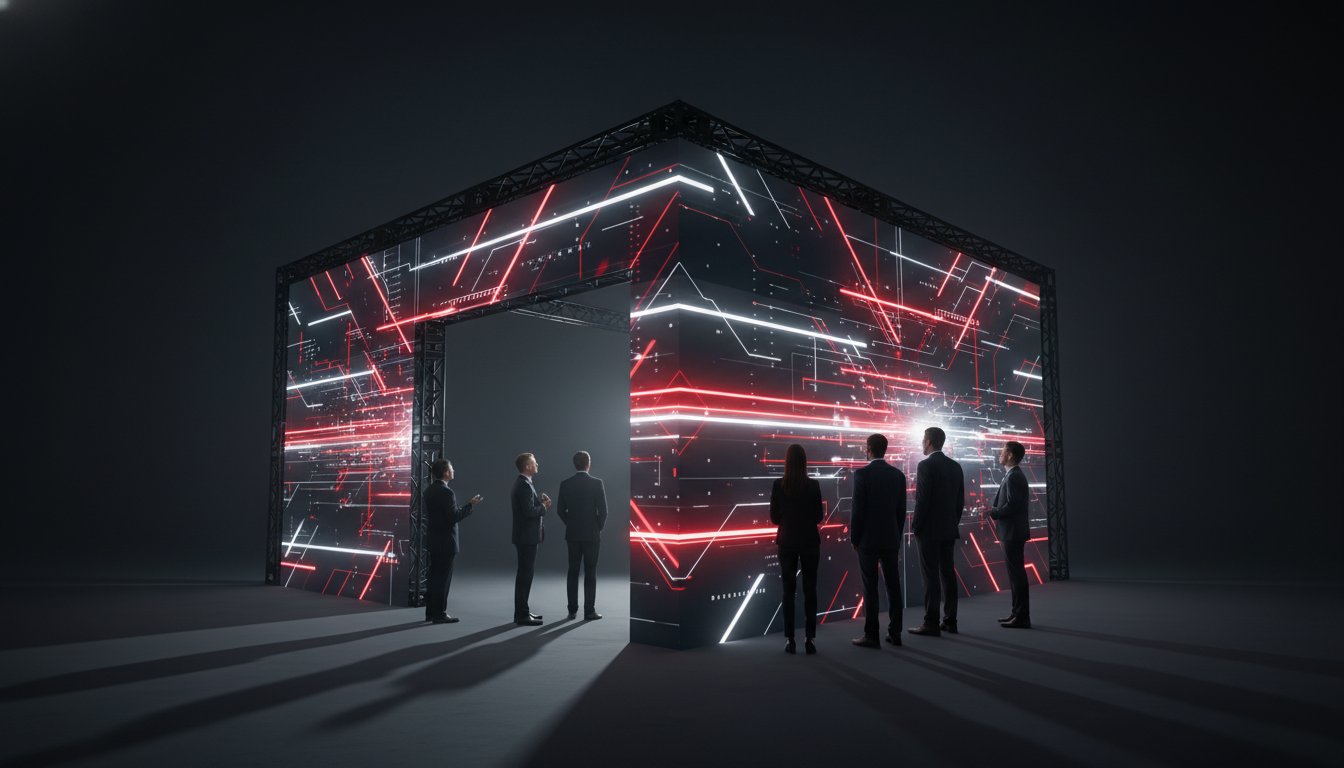
Did you know that digital displays attract 400% more attention than static, printed graphics on a crowded exhibit floor? In 2026, a video wall for trade show booth environments is no longer just a screen. It is a structural architectural element that dictates how visitors move and interact with your brand. We understand the pressure of high-stakes environments where technical failure is not an option. You want a booth that commands attention, but the confusion over pixel pitch, viewing distances, and complex venue rigging logistics can feel overwhelming.
This guide provides the technical mastery you need to leverage professional LED video walls to dominate the floor and maximize your ROI. You'll learn how to choose the right resolution for your space, manage power requirements, and navigate the latest 2026 safety regulations. We'll preview the essential design trends and technical benchmarks that ensure your next production is both visually transformative and operationally seamless. From pixel pitch standards to California specific rigging permits, you will gain the clarity needed for a flawless execution.
Key Takeaways
- Gain a competitive edge by leveraging the superior brightness and modular versatility of modern LED technology in high-ambient light environments.
- Navigate technical specifications with ease by applying the "Viewing Distance Rule" to select the optimal pixel pitch for your video wall for trade show booth.
- Transform your exhibit space using high-impact configurations like immersive L-shapes and digital portals that guide attendee flow and engagement.
- Secure your technical execution by mastering the complexities of power consumption, rigging regulations, and venue-specific material handling.
- Discover how full-service production management protects your ROI by providing on-site support and seamless integration of audio, visual, and lighting systems.
Why a Video Wall for Trade Show Booths is the 2026 Gold Standard
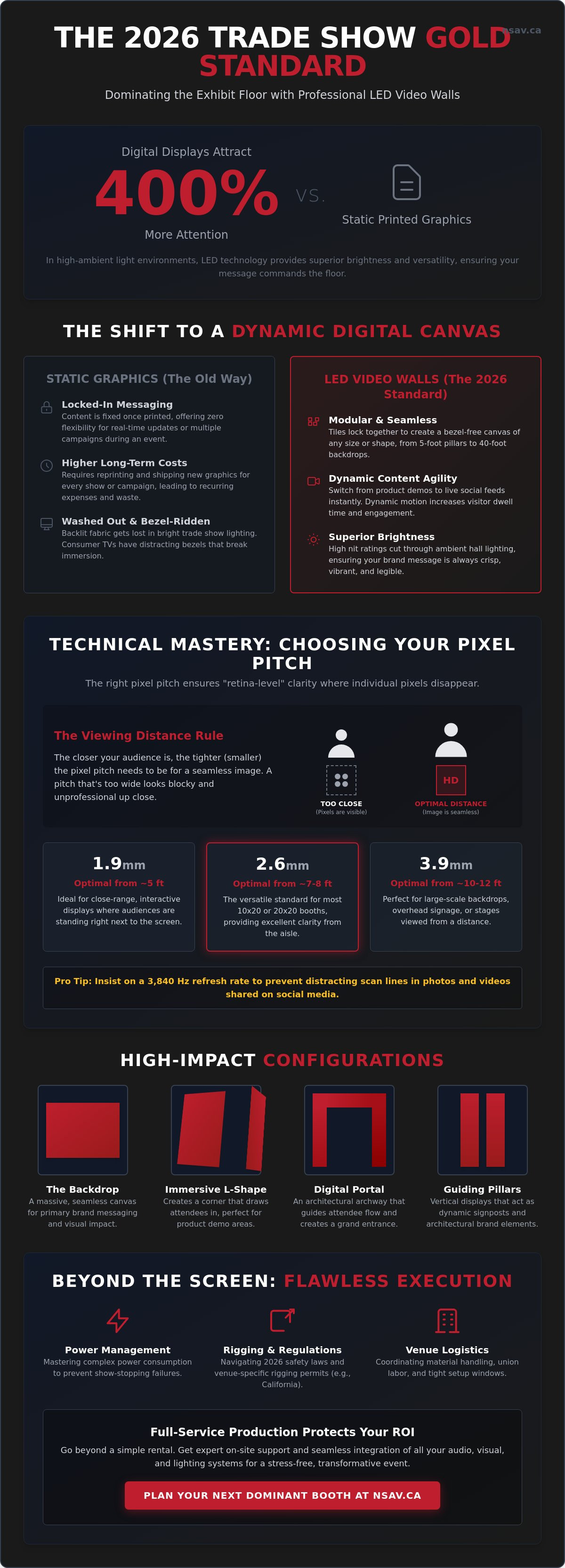
In the high-stakes environment of a 2026 trade show, standing out requires more than just a presence. It requires dominance. The modern LED video wall for trade show booth designs has evolved from a premium addition into a structural necessity. Unlike older projection systems or static signage, these high-brightness displays are modular, allowing them to scale to any footprint. They offer a transformative visual impact that traditional graphics can't match. According to industry data from February 2026, digital displays attract 400% more attention than printed alternatives. This isn't just about aesthetics; it's about capturing a larger share of the audience's limited attention span.
Trade show halls are notoriously difficult environments for visual clarity. High-ambient lighting from overhead rigs often washes out standard monitors and backlit fabric. LED panels solve this through superior nit ratings, ensuring your brand message remains crisp and legible from across the hall. This technical mastery over light ensures that your content isn't just visible. It's vibrant. By utilizing advanced Video Wall Technology, exhibitors can maintain high-resolution clarity even in the brightest convention centers.
The Shift from Static Graphics to Dynamic Digital
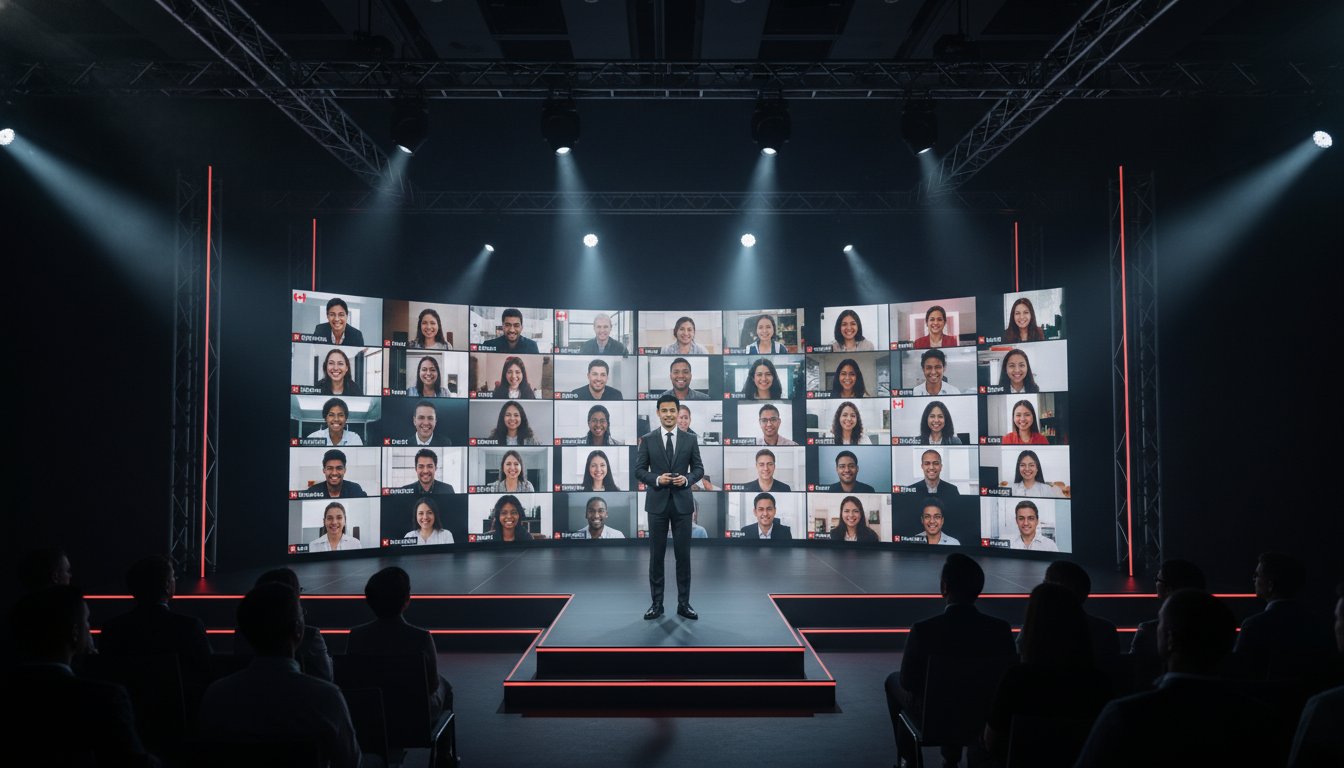
Backlit fabric skins were once the industry standard, but in 2026, they're losing ground to active LED technology. The reason is simple: agility. A physical graphic is locked in once it's printed. In contrast, an LED wall allows for real-time content updates. You can switch from a product demo to a live social media feed or a lead leaderboard with a few keystrokes. This flexibility reduces the long-term costs of reprinting materials and keeps your booth relevant throughout a multi-day event. It also encourages longer dwell times, as dynamic motion naturally draws the eye and keeps visitors engaged with your messaging.
Modular vs. Traditional Large-Format Displays
Many exhibitors make the mistake of using consumer-grade TVs. These units suffer from glare and distracting bezels that break the visual flow. Professional Audio Visual Rentals provide a "no-bezel" design, where modular tiles lock together to create a seamless canvas of any size. Whether you're building five-foot pillars to guide traffic or a massive 40-foot backdrop, modularity ensures the display fits your booth's specific architecture. This scalability allows for creative configurations that traditional displays simply can't achieve, turning a standard booth into an immersive brand experience.
Technical Specifications: Choosing Pixel Pitch and Resolution
Technical mastery starts with understanding the hardware. Pixel pitch, or the physical distance between the centers of two adjacent LED clusters, directly influences how your audience perceives your brand. For a video wall for trade show booth, the goal is "retina-level" clarity where individual pixels disappear into a seamless image. If the pitch is too wide, your content looks blocky and unprofessional. If it's unnecessarily tight, you're overspending on resolution that the human eye can't even process from the aisle.
The "Viewing Distance Rule" is your most critical metric. In a standard 10x20 or 20x20 booth, visitors typically stand between 3 and 10 feet from your display. To maintain a sharp image at these ranges, you must align your hardware choice with your booth's footprint. Social media engagement also depends on your technical specs. If your wall doesn't meet the 2026 refresh rate standard of 3,840 Hz, attendees will see distracting scan lines in the photos and videos they take of your booth. This technical detail is a cornerstone of modern Trade Show Technology Trends, ensuring your brand looks as good on a smartphone screen as it does in person.
Pixel Pitch Comparison Table for 2026
Choosing the right pitch balances visual impact with budget efficiency. Here is how the most common 2026 panels compare:
| Pitch (mm) | Min Viewing Distance | Ideal Application |
|---|---|---|
| 1.2mm | 3 - 4 Feet | Interactive kiosks and touch-screens. |
| 1.9mm | 6 - 8 Feet | The "Sweet Spot" for 20x20 booth backdrops. |
| 2.6mm | 10+ Feet | High-mounted headers and large perimeter walls. |
Understanding Brightness (Nits) and Contrast
Trade show halls are flooded with competing light sources. To maintain "pop," your video wall for trade show booth needs a brightness rating of at least 1000 nits. This allows your content to cut through the overhead glare without appearing washed out. High-end brands often opt for "Black Body" LEDs. These use a darker casing around the diode to achieve deep, rich contrast levels that standard LEDs can't match. Calibration is the final step. Our team ensures your wall is bright enough to attract attention but tuned correctly so it doesn't blind visitors standing within your booth. Consult with our specialists for custom LED configurations tailored to your specific booth architecture.
Creative Examples: 4 High-Impact Video Wall Configurations
A video wall for trade show booth success isn't just a flat surface. It's a structural element that dictates how visitors move and interact with your brand. By thinking beyond the standard rectangle, you can guide visitor movement and create architectural depth that pulls people in from the aisle. Creative configurations transform a booth from a simple stall into a destination. These designs leverage the modular nature of LED tiles to create shapes and perspectives that traditional displays simply can't mimic.
Configuration 1: The Immersive Corner Wrap
Island booths benefit significantly from the L-shape setup. By wrapping two sides of a corner, you create a theatre feel that draws attendees into your brand's world. This configuration allows for 3D content that appears to pop out of the screen toward the viewer. Technical precision is key here. Using 45-degree mitered tiles ensures a seamless edge where the two walls meet, eliminating any visual gap. Our team at Northern Signal AV Ltd. specializes in these custom designs to ensure structural integrity and visual perfection.
Configuration 2: The LED Pillar & Totem
Space is often at a premium in 10x10 booths, but that shouldn't limit your impact. Vertical totems or pillars provide a clever solution. These thin strips of LED display tall, eye-catching product shots or live data feeds without consuming valuable floor space. They also serve as effective directional signage within larger pavilions, helping visitors locate your team in a crowded hall. This approach aligns with best practices from the Digital Signage Federation, which emphasizes using dynamic content to optimize spatial communication.
Configuration 3: The "Flown" Floating Header
Maximizing your air rights is the fastest way to get noticed in a massive convention hall. A floating video wall for trade show booth visibility can be seen from the far corners of the building. These rings or squares are suspended above the booth, providing 360-degree brand exposure. Rigging these structures requires careful planning and coordination with the venue for ceiling points. For those exhibiting in specific regions, checking our LED Wall Rental Edmonton guide offers localized rigging tips and regional compliance advice.
Configuration 4: The Digital Portal & Curved Canvas
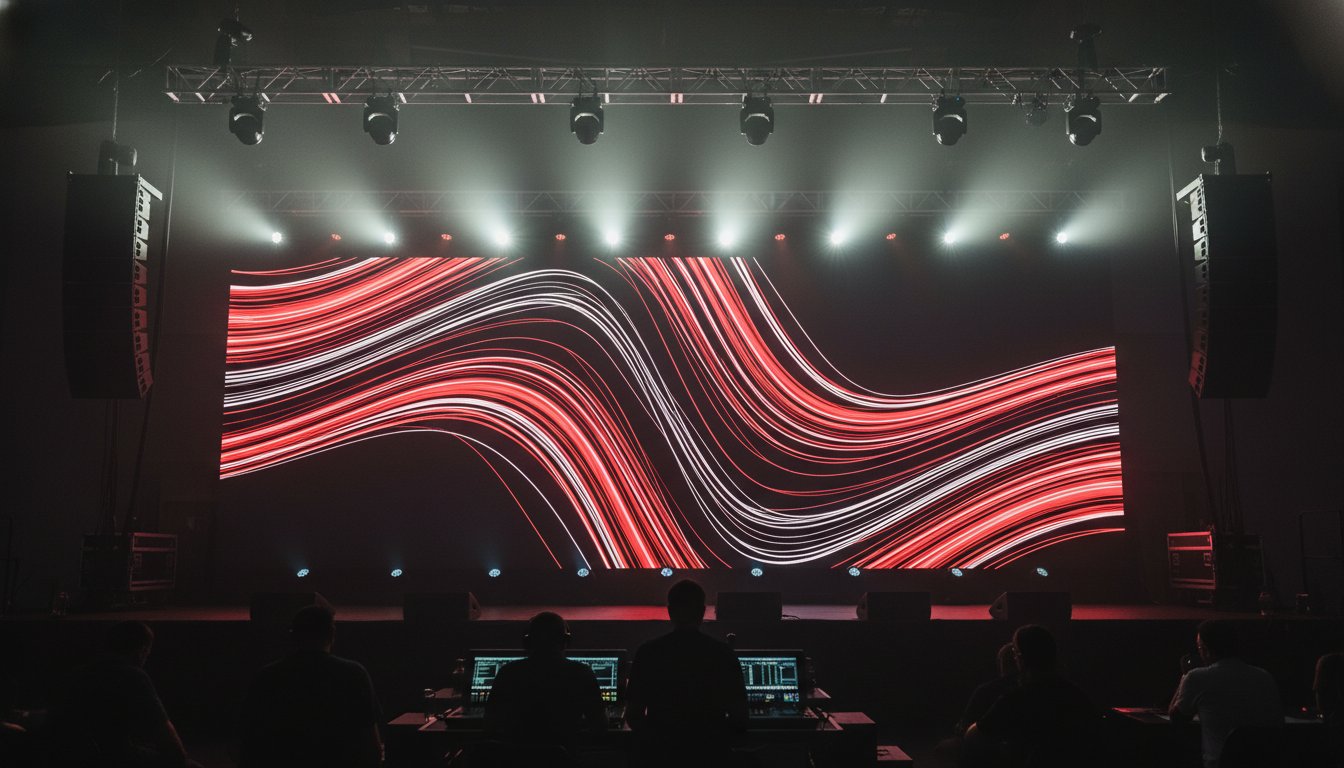
Framing your entrance with LED tiles creates a digital portal that welcomes visitors into your space. It acts as a gateway, signaling that the experience inside is different from the common aisle. For a more organic feel, curved tiles allow for convex or concave shapes. These curves break the harsh lines of traditional booth construction, making the environment feel more inviting and sophisticated. Whether you're framing a doorway or creating a wave-like backdrop, these shapes ensure your brand is the most memorable on the floor.
Trade Show Logistics: Power, Rigging, and Venue Rules
Logistics are where even the most creative booth designs face their toughest test. Successfully deploying a video wall for trade show booth environments requires more than just high-end hardware; it demands a deep understanding of venue infrastructure. Technical failure often stems from overlooked details like power distribution or rigging certifications. In 2026, convention centers have stricter safety protocols than ever. For example, many venues now require professional engineering (PE) stamps for any suspended LED structures. Planning these details 4 to 6 weeks in advance is the only way to avoid the "floor rate" surcharges that can devastate a production budget.
Power & Data Management
LED panels are power-intensive. A common mistake is assuming standard booth power can handle both your lighting and a massive display. You must calculate the total amperage required to avoid tripped breakers during peak show hours. We recommend dedicated circuits for your video wall to prevent interference from other appliances like coffee machines or high-powered laptops. Data integrity is equally vital. We utilize redundant signal loops; if one cable fails, the screen remains active. Relying on a simple USB stick is risky. A local media server provides the processing power needed for seamless, high-resolution playback without stuttering.
Navigating Canadian Trade Show Venues
Western Canadian hubs like the Edmonton EXPO Centre and the Calgary Telus Convention Centre have specific operational nuances. While these venues often have in-house providers, exhibitors have the right to bring in their own professional production management team for specialized LED work. The key is managing the hand-off between your team and the venue's union labor. Understanding who is permitted to touch the "points" in the ceiling versus who manages the screen assembly can save hours of onsite frustration.
Drayage, or material handling, is another factor to consider. Shipping your LED tiles in specialized flight cases requires precise weight and dimension calculations to manage the costs of moving gear from the loading dock to your booth space. Content compatibility is the final hurdle. You must ensure your media is rendered to the exact pixel resolution and aspect ratio of your custom wall to avoid stretching or black bars. To ensure your technical logistics are handled with absolute precision, contact our production specialists to review your booth's specific site requirements.
Why Full-Service Production Management Beats Simple Rental
Renting hardware is the easiest part of trade show planning. Mastering the execution is where the real challenge lies. A video wall for trade show booth use is a complex ecosystem of power, data, and content that requires constant monitoring. Many exhibitors choose a simple equipment drop-off to save on upfront costs, but this often leads to day-of panic when a single tile fails or content won't play. Choosing full-service production management means you're hiring a partner to handle the technical heavy lifting, allowing your sales team to focus on lead generation.
The "Dead Pixel" risk is a reality on high-traffic trade show floors. Equipment gets bumped during booth set-up, and electronics can fail under the heat of convention center lights. Without professional technical support on-site, a single dark tile in the middle of your brand film becomes a distracting eyesore. We provide a steady hand in these high-stakes environments, ensuring that your visual investment remains flawless from the opening keynote to the final teardown.
The Value of On-Site Technical Support
Real-time troubleshooting is the primary benefit of professional management. If a hardware issue arises, our technicians can swap faulty tiles or adjust signal processors in minutes, not hours. We also manage the subtle details that define a premium experience, such as smooth transitions between different presentation decks or live social feeds. For exhibitors in Western Canada, our Calgary Event Production teams provide the localized reliability needed to navigate regional venue rules and labor requirements seamlessly.
Creating a Synchronized AV Experience
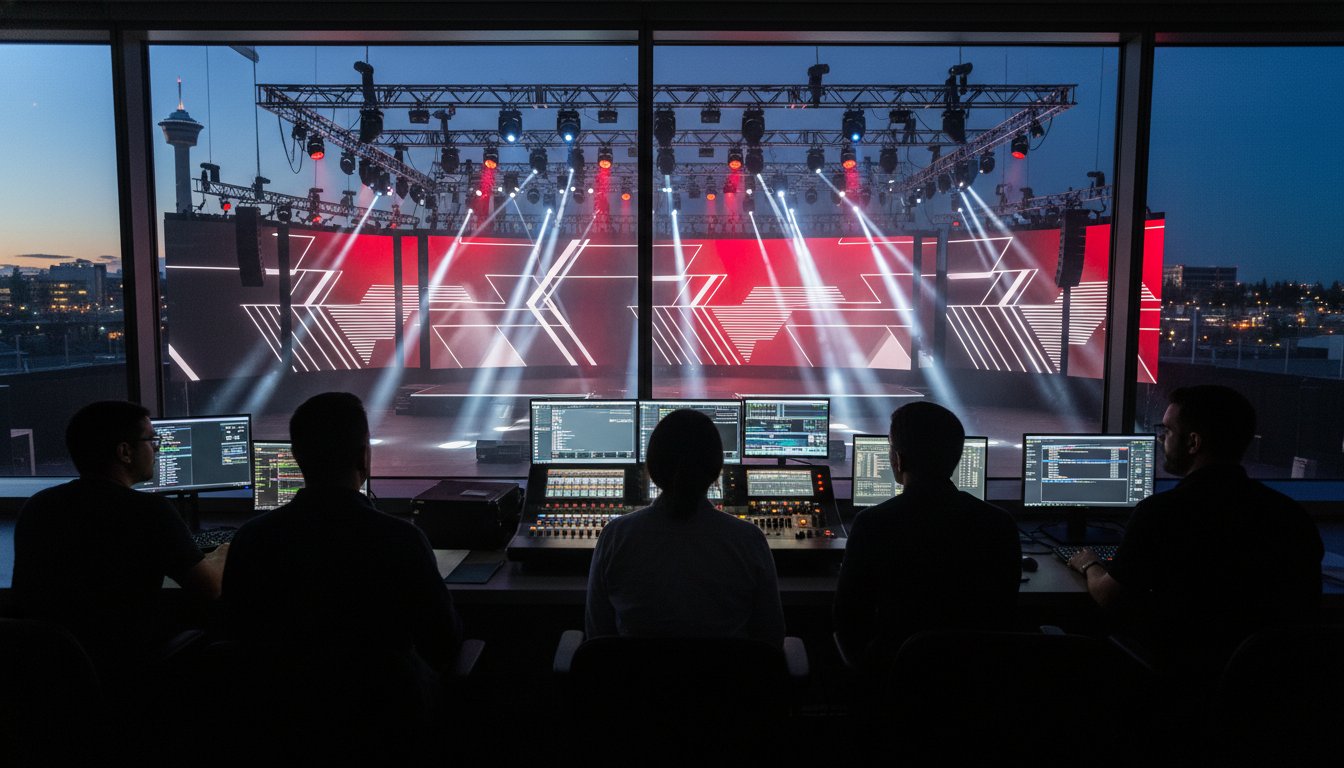
A video wall shouldn't exist in a vacuum. To maximize impact, your visual content must be synchronized with your booth's lighting and audio. We use event lighting to complement the color palette of your on-screen media, creating a cohesive brand environment that feels intentional. Audio is equally critical. In a noisy hall, directional audio systems ensure your message is heard clearly by those standing in your booth without contributing to the general floor noise. You can learn more about these integrations in our Professional Audio Systems Pillar guide.
Content optimization is the final piece of the puzzle. Most corporate videos are rendered in standard 16:9 ratios, but custom video wall for trade show booth designs often use non-standard resolutions. Our production management services include formatting your media to fit your specific LED canvas perfectly. This prevents awkward stretching or black bars that diminish your brand's authority. With local expertise spanning Alberta and Ontario, Northern Signal AV Ltd. ensures your technical execution is as elite as your brand's vision.
Dominate Your Next Trade Show Appearance
A successful exhibit relies on the perfect intersection of creative vision and technical precision. By mastering pixel pitch selection and navigating the complexities of venue power and rigging, you ensure your brand stands out in a crowded hall. Implementing a high-performance video wall for trade show booth environments isn't just about the hardware; it's about the reliability of your technical partner. Seamless execution requires foresight, from content optimization to on-site troubleshooting.
We provide the steady hand you need in high-stakes environments. Our 2026-ready high-resolution LED inventory and full technical production management guarantee a flawless presentation. With dedicated local support in Edmonton, Calgary, and across Canada, we handle the logistics so you can focus on building connections. Don't leave your booth's ROI to chance with simple equipment rentals when you can have elite mastery over every technical detail.
Request a Custom Video Wall Quote for Your Next Show and transform your exhibit into a high-impact destination. Your brand deserves a stage that commands attention.
Frequently Asked Questions
What is the best pixel pitch for a trade show video wall?
A pixel pitch of 1.5mm to 1.9mm is the current 2026 gold standard for most booths where visitors stand 6 to 10 feet away. This ensures a crisp, high-resolution image that maintains brand integrity without visible pixels. For headers or signs mounted higher than 10 feet, a 2.6mm pitch provides a cost-effective balance between clarity and budget.
How much power does a typical LED video wall use at a trade show?
A typical LED video wall for trade show booth setups requires significant power, often drawing between 500 and 800 watts per square meter at peak brightness. Most exhibitors need to order multiple dedicated 20-amp circuits from the venue to prevent tripped breakers. It's vital to coordinate these requirements with your production team at least 30 days before the show.
Can I use a standard 16:9 video on a custom-shaped LED wall?
You can play standard 16:9 video on custom-shaped walls, but it will result in black bars or cropped edges. To avoid this, content should be rendered specifically for the wall's unique pixel dimensions. Our production management team ensures your media is optimized for non-standard resolutions so your visuals fill the entire display area seamlessly.
Do I need a rigging permit for a floating video wall in Calgary or Edmonton?
Rigging permits and professional engineering stamps are mandatory for suspended structures at major venues like the BMO Centre or Edmonton EXPO Centre. These regulations ensure that any "flown" video wall meets strict overhead safety standards. We handle the submission of these technical drawings to ensure your booth complies with all local Alberta safety bylaws.
What is the difference between an indoor and outdoor LED wall for exhibitions?
The primary differences are brightness levels and weather protection. Indoor panels are designed for detail and typically offer 800 to 1,200 nits of brightness. Outdoor panels require 5,000 nits or more to compete with direct sunlight and feature IP65-rated enclosures to protect against rain and dust, which is unnecessary for climate-controlled exhibition halls.
How long does it take to set up a 20-foot video wall in a booth?
A 20-foot wide video wall typically takes 4 to 6 hours to assemble, calibrate, and test. This timeline depends on whether the wall is ground-stacked on a base or rigged to the ceiling. Complex configurations with integrated audio and lighting may require additional time for synchronization and signal redundancy testing.
Can I interact with the video wall using a touchscreen or mobile device?
Interactive capabilities are highly effective, allowing visitors to trigger content via touch-sensitive overlays or mobile device integration. Using QR codes on the screen, attendees can control elements of the display from their own smartphones. This creates a personalized experience that significantly increases attendee dwell time within your booth.
Should I rent or buy a video wall for my annual trade show appearances?
Renting is generally the superior choice for most exhibitors due to the rapid pace of technological advancement and the high cost of maintenance. Professional rentals include technical support and the latest high-resolution inventory. Purchasing only makes sense if you exhibit more than four times annually and have the internal staff to manage logistics, storage, and repairs.