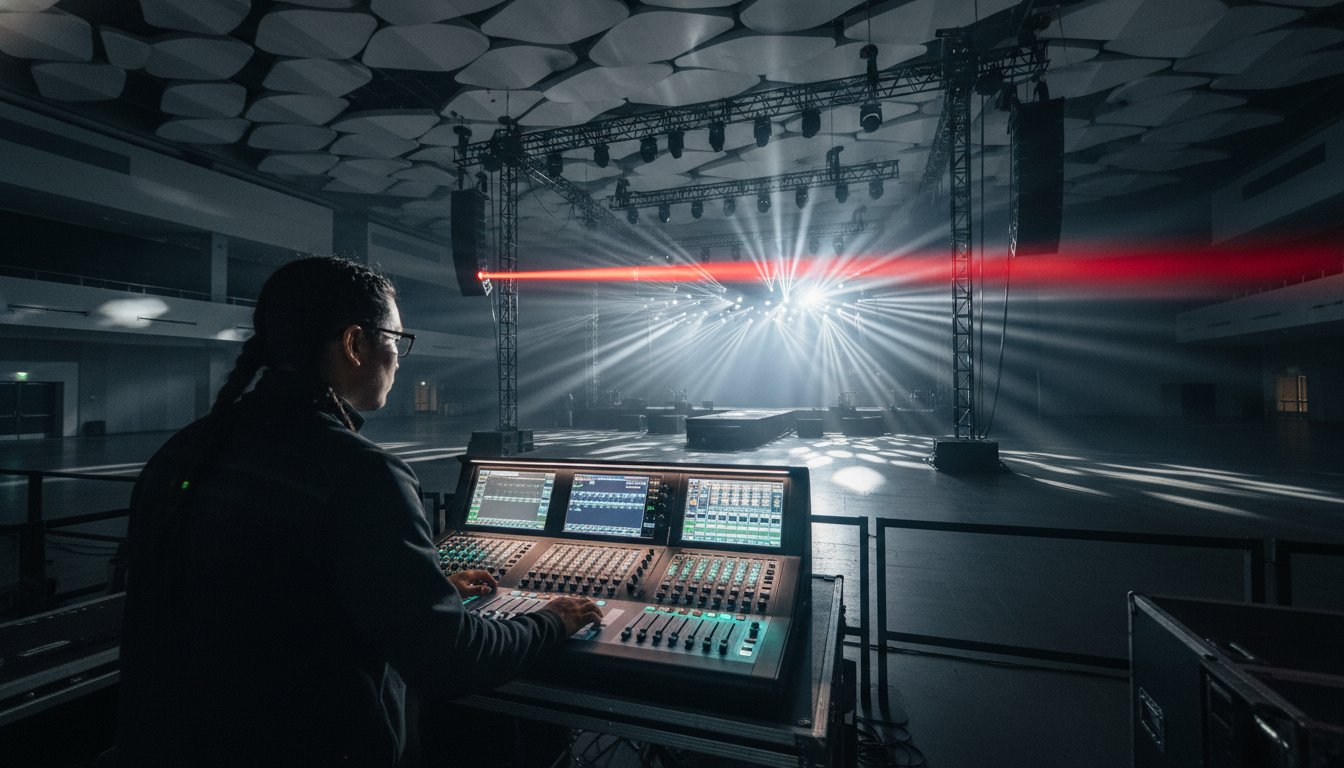
What if the most expensive microphone in your kit isn't the solution to your audio woes? Most production teams chase gear upgrades when the real secret to high-fidelity sound lies in a disciplined "System-First" signal chain and proactive acoustic management. You've likely felt the sting of a feedback loop piercing through a keynote or the frustration of muffled speech that leaves half your audience straining to hear. These technical failures, especially in complex hybrid environments, can undermine even the most polished presentations. You deserve a technical execution that feels effortless and sounds impeccable.
This guide reveals the exact technical strategies and production workflows used by experts to deliver crystal-clear audio for events of any scale. You'll learn how to improve event audio quality by mastering frequency coordination in the 470-608 MHz UHF band, leveraging the 65% of equipment now featuring AI-driven adjustments, and transitioning to AV over IP as the industry default. We'll provide a framework for evaluating your AV production services and managing technical support to ensure high intelligibility for every attendee, whether they're in the front row or joining from a remote stream.
Key Takeaways
- Master the science of audio intelligibility by applying the Inverse Square Law to ensure clear speech reaches every corner of your venue.
- Optimize the professional signal chain from transducer to room processing to eliminate feedback and maintain consistent volume levels.
- Discover how to improve event audio quality by using professional staging and pipe and drape to neutralize acoustic challenges like echo and sound reflections.
- Implement a disciplined technical production workflow that prioritizes dedicated "Quiet Time" for precision soundchecks and system calibration.
- Scale for high-capacity crowds and outdoor environments by transitioning to line array systems and managing environmental factors for mobile stage rentals.
Understanding the Foundation of Audio Intelligibility
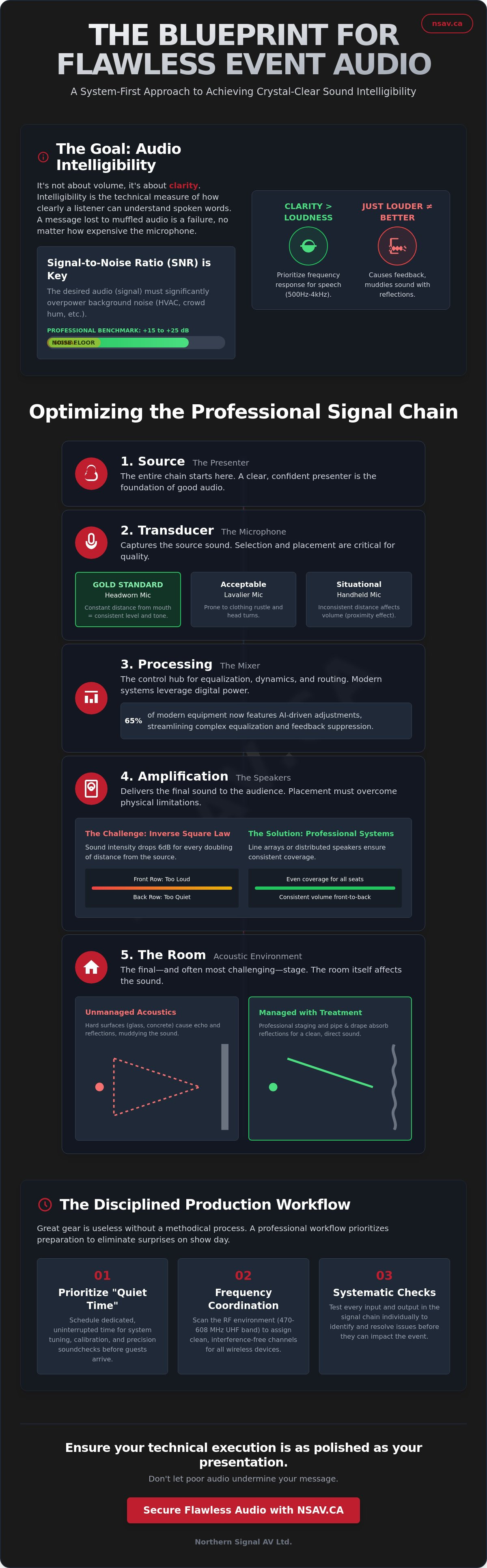
Audio intelligibility is the precise measure of how clearly a listener can understand spoken words. It's not a subjective feeling of "good sound" or "rich bass." It's a technical metric of clarity. If your audience can't decipher the consonants in a speaker's sentence, your message is effectively lost. A professional sound reinforcement system must prioritize this clarity above all else. When considering how to improve event audio quality, you have to adopt a "System-First" mindset. This means evaluating the entire room's acoustics and the interaction between every component rather than just focusing on the microphone brand.
The biggest challenge to intelligibility is the Inverse Square Law. This physical principle dictates that sound intensity decreases by 6 decibels every time the distance from the source doubles. If you rely on a single speaker pair at the front of a deep ballroom, the front row is blasted with excessive volume while the back row struggles to catch every word. Technical experts compensate for this drop-off by using distributed audio systems or line arrays. These tools maintain consistent energy throughout the venue, ensuring the experience is uniform for every attendee regardless of their seat.
The Science of Signal-to-Noise Ratio (SNR)
Clarity depends on the relationship between the desired signal and the ambient noise floor. In many Canadian corporate venues, HVAC systems, kitchen clatter, or street traffic create a high noise floor that competes with your presenters. Increasing the volume doesn't solve this if you're simply amplifying the room's existing hiss. To achieve professional benchmarks, you need a signal that is at least 15 to 25 dB above the noise floor. Identifying these sources of acoustic interference early allows a technical team to mask or eliminate them before the first keynote begins.
Audio Intelligibility vs. Volume
Louder is rarely better. In fact, excessive volume often triggers feedback loops and increases room reflections, which only serve to muddy the sound. High-quality production services focus on frequency response rather than raw power. Human speech primarily lives in the 500 Hz to 4 kHz range. By emphasizing these frequencies and balancing Sound Pressure Levels (SPL) across the room, technicians ensure the voice cuts through the mix. This balance is a hallmark of elite technical execution, allowing for a stress-free environment where the audience doesn't have to work to listen.
Optimizing the Signal Chain: From Input to Output
High-stakes events demand a flawless signal chain. To understand how to improve event audio quality, you must view your setup as a single, interconnected path: the Source (the presenter), the Transducer (the microphone), Processing (the mixer), Amplification (the speakers), and finally, the Room itself. A failure at any point in this sequence degrades the final result. While many beginners focus solely on the microphone, professional audio visual rentals prioritize the synergy of the entire system. This holistic approach ensures that the clarity captured at the stage is the same clarity delivered to the back row.
Modern event production relies heavily on the essential equipment for live sound, specifically digital mixing consoles. These hubs allow for precise control over every input, providing the ability to save "scenes" for different presenters and apply complex processing that was once only available in recording studios. When these tools are paired with strategic speaker placement, you can minimize phase cancellation. This occurs when sound waves from multiple speakers overlap and cancel each other out, creating "dead zones" in the audience. Proper alignment and delay timing ensure every seat receives a coherent, impactful signal.
Microphone Selection and Placement
Headworn microphones have become the gold standard for corporate keynotes. Unlike handhelds, which can drift away from the mouth, or lavaliers, which often pick up clothing rustle, headworn mics maintain a constant distance from the source. This stability helps technicians manage the proximity effect, a phenomenon where low frequencies increase as the speaker gets closer to the mic. In dense urban environments like Calgary or Toronto, wireless frequency coordination is vital. Professionals now operate primarily in the UHF band between 470 and 608 MHz to avoid the prohibited 600 MHz range, ensuring a clean signal free from local cellular interference.
Processing and Gain Staging
The most common cause of distorted audio is poor gain staging. This is the process of managing the volume levels at each step of the signal chain. If the input gain is too high at the mixer, the audio will clip before it even reaches the speakers. Once a clean signal is established, technicians use Equalization (EQ) to carve out space for the human voice, often by rolling off unnecessary low-end frequencies that cause muddiness. Compression and limiting are then applied to smooth out the volume. This keeps the experience consistent for both the in-person audience and those joining via live streaming & hybrid events, preventing sudden loud peaks from startling listeners.
Advanced Acoustic Management and Venue Preparation
Even the most sophisticated audio system will struggle in a space with poor acoustics. The room is the final component of your signal chain, and it often has the most dramatic impact on clarity. A "Live" room, characterized by hard surfaces like glass, concrete, or parallel walls, reflects sound waves repeatedly. This creates a chaotic environment where echoes overlap and muddy the presenter's speech. Conversely, a "Dead" room with heavy carpeting and acoustic tiling absorbs sound, providing a controlled canvas but requiring more power to reach the back rows. Understanding these dynamics is essential when planning how to improve event audio quality.
Parallel walls are particularly problematic because they create standing waves and flutter echoes. These occur when sound bounces back and forth between two flat surfaces, amplifying specific frequencies and causing "ringing." High ceilings in industrial event spaces or modern ballrooms often lead to long reverberation times, making it difficult for the audience to distinguish individual words. Beyond geometry, you must identify external noise bleed. A humming HVAC system or a loud breakout room next door can instantly compromise your noise floor, forcing your audio team to work harder to maintain a clean signal.
Temporary Acoustic Treatment
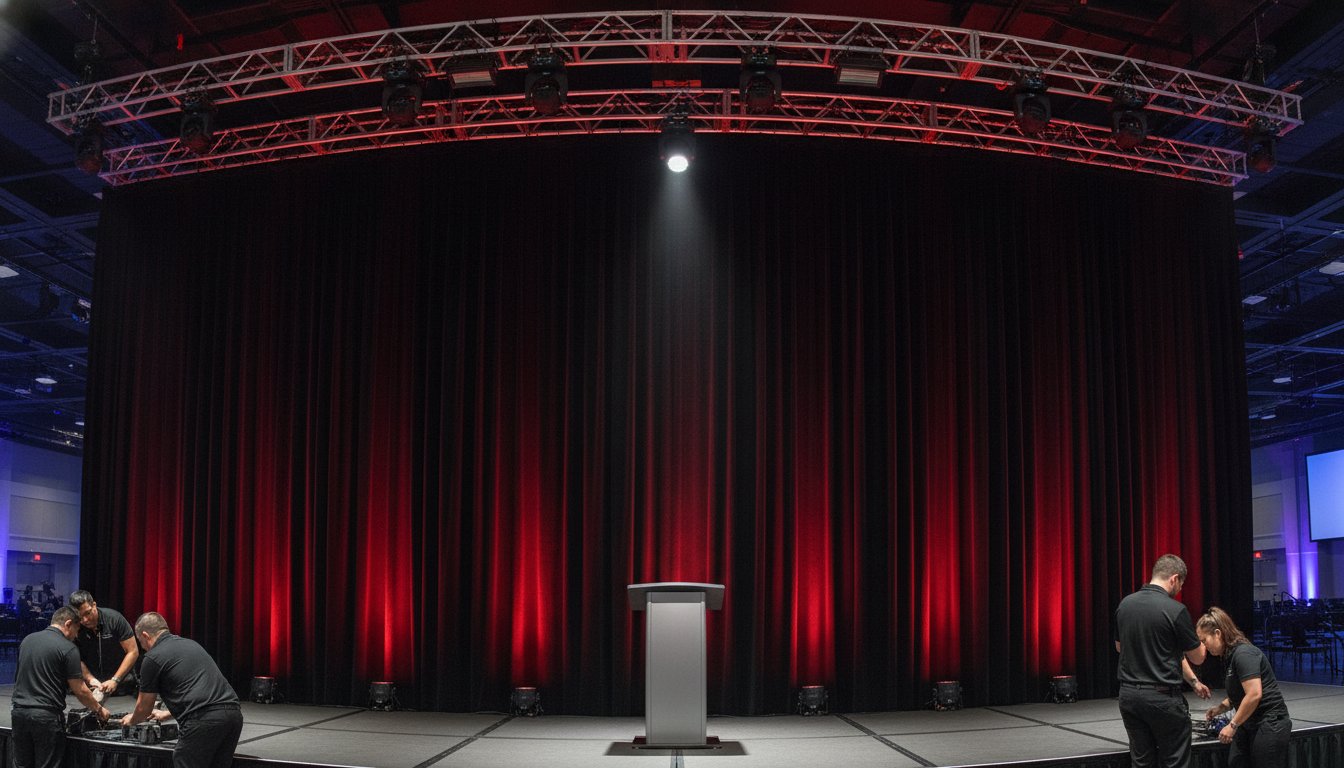
You don't need permanent renovations to fix a room's acoustic flaws. Using pipe and drape rentals is a highly effective way to dampen a space quickly. These heavy, pleated fabrics act as functional acoustic absorption, catching sound waves before they hit hard surfaces and bounce back into the audience. Strategic placement behind the stage or along large glass windows eliminates "slap-back" echoes. The floor also plays a significant role. If you're working on a concrete or hardwood surface, adding area rugs or opting for carpeted spaces will significantly reduce high-frequency reflections and improve the overall warmth of the mix.
Venue Mapping and Time Alignment
In long ballrooms, such as those found in major Edmonton or Calgary convention centers, sound from the main stage speakers loses energy and clarity before it reaches the back. Delay speakers are the professional solution. This involves a technical process of time-aligning secondary speakers so that sound from the front and the middle reaches the listener's ear at the exact same millisecond. Technicians use pink noise and Real-Time Analyzers (RTA) to tune the room, ensuring a flat frequency response. This level of precision is also a core part of any technical guide to live show recording, as a well-tuned room is the foundation for both the live experience and the final archive.
The Technical Production Workflow: From Load-In to Soundcheck
Technical excellence requires a rigid production timeline. A successful load-in isn't just about moving boxes; it's about sequence. Establishing "Quiet Time" on the schedule is non-negotiable. This is a dedicated window where all other vendors, from decorators to caterers, cease loud activity. It allows the audio team to hear the room's response without interference. Effective production management ensures this schedule is respected, which is the first step in learning how to improve event audio quality. Without this silence, fine-tuning the system becomes a guessing game.
Managing the feedback loop starts before the first attendee arrives. The Front of House (FOH) engineer and the stage manager must work in perfect sync. They identify problematic frequencies that "ring" and cut them using narrow-band EQ filters. This proactive approach increases the gain-before-feedback, allowing the presenter to move freely without causing a piercing squeal. With 65% of modern audio equipment now featuring AI-driven adjustments as of 2026, many of these corrections can be automated. However, a skilled engineer's ear remains the ultimate authority for high-stakes environments.
The Professional Soundcheck Checklist
- Step 1: Verify signal flow and phantom power for all inputs. Ensure that every cable and wireless transmitter is delivering a clean, healthy signal to the console.
- Step 2: Ring out the monitors and the main PA. This involves intentionally pushing the volume until it begins to feed back, then identifying and neutralizing those specific frequencies.
- Step 3: Conduct a physical "walk-around." The engineer must move through the venue to verify coverage in every corner, ensuring no seat is left in an acoustic shadow.
Managing Remote and Hybrid Audio
Hybrid events introduce the challenge of the "Mix-Minus." This technical routing ensures that remote speakers hear everything from the room except their own voice, preventing a distracting echo. Separate mixes are essential. What sounds balanced on a large audio system in a ballroom will often sound thin or unbalanced on a live stream. Technicians must also prioritize redundancy. If a primary audio interface fails, a secondary system must be ready to take over instantly without the audience noticing a dip in quality. This level of preparation is what separates a standard meeting from a world-class production.
For a seamless technical execution that guarantees your message is heard, consider partnering with an elite Calgary event production team to manage your next high-stakes program.
Scaling Audio for Large-Scale Productions and Outdoor Stages
Large-scale productions demand a fundamental shift in how we approach sound distribution. While point-source speakers are efficient for smaller rooms, they lack the projection required for massive crowds or open-air environments. Professional teams utilize line array systems to solve this. These vertically stacked speakers use constructive interference to create a cylindrical wave, which loses energy much more slowly than the spherical wave of a standard speaker. Mastering these physics is a critical part of how to improve event audio quality when your audience grows from hundreds to thousands.
Beyond the speakers, large setups face the risk of ground loops and power distribution issues. The dreaded "hum" often originates from different equipment being plugged into separate electrical circuits with varying ground potentials. Technicians must use power sequencers and balanced lines to isolate these issues. Subwoofer positioning also requires a strategic hand. Instead of simply placing them on the stage, using an end-fire or cardioid array can steer low-end energy toward the crowd while keeping the stage itself quiet and clear. This level of control ensures the bass is impactful without muddying the vocal frequencies.
Line Array Physics for Large Venues
Line arrays provide a consistent volume profile from the front row to the back. This uniformity is achieved through precise splay angles between each speaker cabinet. Rigging these systems requires adherence to strict Calgary event production standards to ensure structural safety. Engineers use predictive software to model sound coverage before any equipment is hung, allowing for a digital rehearsal of the acoustic environment. This precision prevents "hot spots" and ensures that every attendee experiences the same high-fidelity audio, regardless of their distance from the stage.
Outdoor Audio Logistics
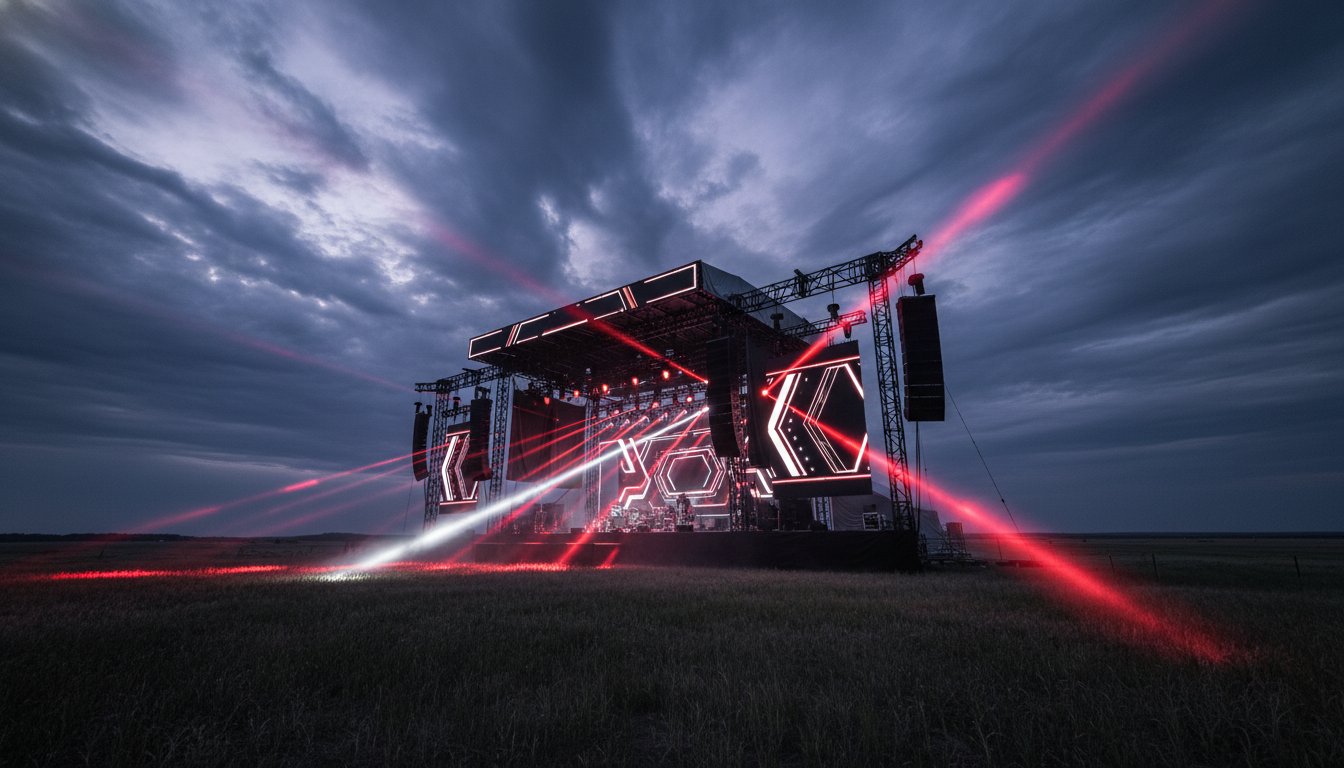
Managing outdoor events in Alberta and Saskatchewan requires a specialized approach to environmental factors. Wind noise can easily ruin speech clarity, making high-pass filters and specialized wind-screens essential tools for any technician. When utilizing mobile stages, protecting sensitive electronics from unpredictable weather is a top priority. Rain covers and climate-controlled racks keep the signal chain operational. Professional technical support is non-negotiable for large-scale festivals. It's the only way to ensure that how to improve event audio quality remains a reality, even when facing high gusts or sudden temperature shifts that can alter how sound travels through the air.
Mastering the Future of Event Sound
Audio excellence is no longer just about the gear you rent. It's about a holistic approach that pairs high-level physics with a disciplined production workflow. By mastering the signal chain and proactively managing venue acoustics with tools like pipe and drape, you ensure that every seat in the house receives crystal-clear intelligibility. Understanding how to improve event audio quality requires looking beyond the microphone and focusing on the interaction between the system and the room itself.
Technical precision is the foundation of a transformative audience experience. Whether you're planning a corporate keynote or a large-scale outdoor festival, our expert engineers bring concert-grade experience and 2026-ready digital audio consoles to every project. We provide comprehensive production management across Western Canada to take the stress out of your technical execution. Contact Northern Signal AV Ltd. for a professional technical assessment of your next event.
Your message is too important to be lost in the noise. With the right technical partner, your next event will sound as professional as it looks.
Frequently Asked Questions
Why does my event audio keep producing high-pitched feedback?
Feedback occurs when a microphone captures its own amplified signal from the speakers, creating a continuous loop. This is usually caused by poor microphone placement or excessive gain settings on the mixing console. Professional technicians prevent this by "ringing out" the system during soundcheck, which involves identifying and cutting the specific frequencies prone to feedback before the audience arrives.
What is the best type of microphone for a corporate presentation?
Headworn microphones are the gold standard for keynotes because they maintain a constant distance from the speaker’s mouth. This ensures a stable signal even if the presenter moves their head or walks around the stage. While handheld microphones are versatile and lavaliers offer a discreet look, headworn mics provide the highest level of gain-before-feedback and vocal clarity.
How can I improve audio quality in a room with high ceilings and echoes?
You can manage acoustic reflections by using soft goods like pipe and drape to dampen hard surfaces like glass or concrete. Strategic speaker placement and the use of delay speakers help focus sound directly on the audience rather than the ceiling. This technical approach is a primary strategy for how to improve event audio quality in large, reverberant ballrooms.
Do I really need a professional sound engineer for a small event?
A professional sound engineer acts as a steady hand, ensuring technical reliability even for minor equipment needs. They manage gain staging, monitor for wireless interference, and provide immediate troubleshooting if a technical failure occurs. Having an expert on site alleviates stress and guarantees that your message is delivered with high intelligibility to every attendee in the room.
What is a "Mix-Minus" and why is it important for hybrid events?
A mix-minus is a custom audio bus that sends all room audio to remote participants except for their own voice. This prevents the remote speaker from hearing a delayed echo of themselves, which can be incredibly distracting during a presentation. It's an essential technical routing for seamless live streaming & hybrid events where clear two-way communication is required.
How much does it cost to rent a professional sound system in Calgary?
Rental costs depend on the audience scale and the specific components required, such as digital consoles or wireless microphone systems. A system for a small 200 person meeting has different technical requirements than a line array for a massive crowd. You should check with a local authority for a customized technical assessment to ensure you receive a reliable solution for your specific venue.
How do I stop wind noise from ruining my outdoor event recording?
Use high-quality windscreens or foam covers on all microphones to physically block air movement from reaching the capsule. Additionally, applying a high-pass filter at the mixing console can cut out the low-frequency rumble typically associated with wind. These steps are crucial for maintaining speech clarity during outdoor mobile stage rentals in unpredictable regional weather conditions.
What is the difference between a line array and a standard speaker?
Standard point-source speakers radiate sound in a spherical pattern, causing volume to drop off quickly as you move away from the stage. Line arrays use vertically stacked drivers to create a cylindrical wave that projects sound much further with more consistent volume levels. They are the preferred choice for large-scale productions where you need to cover a deep audience area evenly.